

Key takeaway
AI is changing search in two ways that point in opposite directions for dealers. On one side, Google's AI Overviews are absorbing clicks that used to go to websites — even top-ranked ones. On the other, the AI assistants themselves (ChatGPT, Perplexity) still send dealerships almost no direct traffic. The mistake is to chase "AI traffic" as a new channel. The real shift is that ranking and accurate, structured content now feed both the organic result and the AI answer above it — and the dealers who get cited are the ones whose data is clean and trustworthy.
What is actually changing in search
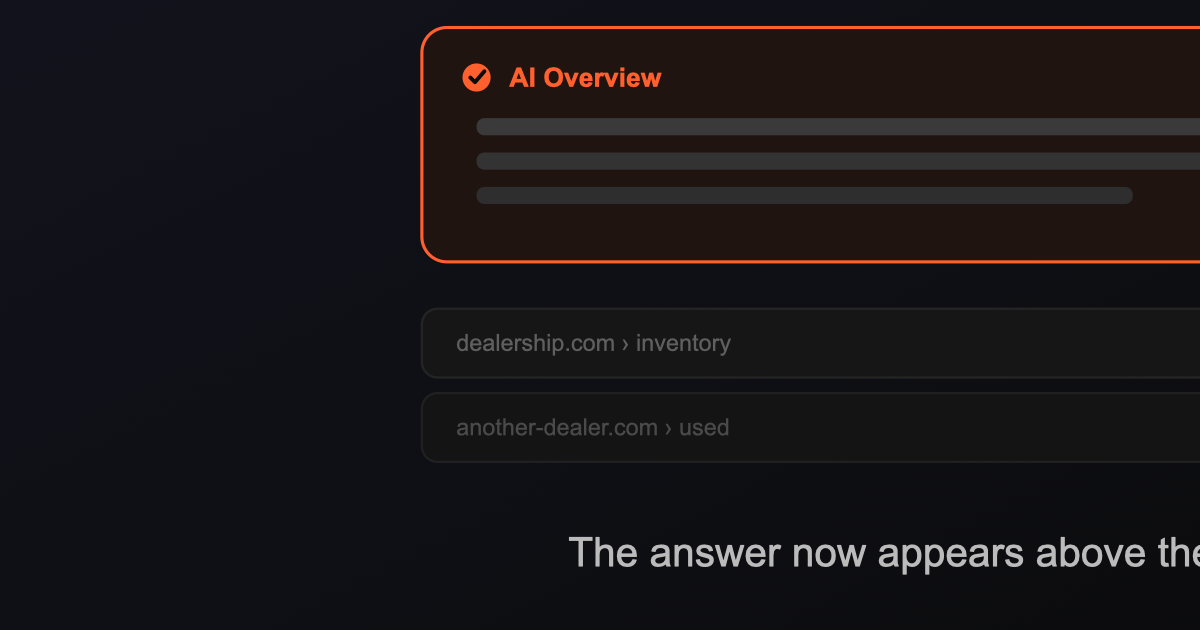
The visible change is the AI Overview — the generated summary Google now places above the organic results. It answers the query in place, so fewer people click through.
Ahrefs measured the effect across 300,000 keywords and found that when an AI Overview is present, the click-through rate on the #1 organic result drops by about 34.5%. A 2026 update put the loss as high as 58% for top-ranking pages (Ahrefs). The trend is not just real; it is accelerating.
For informational queries — "what to look for in a used SUV," "how does dealer financing work," "is a hybrid worth it" — the answer increasingly appears before any dealer link does.
For dealers, "AI traffic" is the wrong thing to watch
It is tempting to read the headlines and start optimizing for ChatGPT. The data says slow down. C-4 Analytics reports that the overwhelming majority of dealerships receive less than 2% of their total traffic from AI platforms like ChatGPT today (C-4 Analytics).
So the operational reality is not "AI is a new traffic source." It is "AI is changing the search results you already depend on." The dealer who ranks #1 still wins — that ranking is now what feeds the AI Overview's summary and citations. The dealer ranked sixth loses twice: once in organic, and again because the AI answer rarely reaches that far down.
What AI answers actually pull from
AI Overviews and assistants assemble answers from sources they can read cleanly and trust. For a dealership, that comes down to a few unglamorous things:
- Structured, machine-readable data. Vehicle schema, clean VDP markup, and a consistent inventory feed make your listings legible to the systems doing the summarizing.
- Accurate, current inventory. An answer engine that finds sold or mispriced units on your site has no reason to trust the rest of it — the same trust problem that an automated inventory feed exists to solve.
- Content that answers real questions. The research, financing, and service questions most affected by AI Overviews are exactly the ones a useful dealer site should answer directly.
- A distinct, authoritative presence. Templated, identical dealer sites are hard to cite. A site built around your brand is easier for both buyers and AI to single out — the case made in why so many dealership websites look the same.
Trust still closes the deal
Even as AI handles more of the research, buyers are not handing it the decision. Only 27% of shoppers say they trust AI as much as a real human salesperson, and 79% value digital transaction tools as trust infrastructure rather than a replacement for the dealership experience (C-4 Analytics).
The practical model that emerges: AI shortlists, humans close. The website's job is to get the dealership onto the shortlist with accurate, citable information, then hand a well-informed buyer to a fast, human follow-up. A lead that arrives after an AI-assisted search is further along — which makes fast, context-rich lead delivery into the CRM matter more, not less.
What dealership websites should do differently
None of this requires chasing a new platform. It is the same SEO fundamentals, sharpened for a world where the answer often appears before the link.
- Rank, because ranking now feeds the AI answer too. Top organic positions are the gateway to AI citations, not a separate game.
- Add and maintain structured data (Vehicle/Car schema, FAQ, organization) so machines can read your inventory and answers correctly.
- Keep inventory accurate and fast — sold/booked units removed quickly, prices and photos current — so AI and buyers both trust the source.
- Write the answers, not just listings. Clear pages on financing, trade-in, and model comparisons are what AI summarizes and what buyers still read.
- Be distinct. A branded, well-structured site is more citable than a template thousands of dealers share.
- Measure the right thing: organic visibility and lead quality, not a tiny "AI referral" number.
Dealer takeaway
The AI search shift is not a reason to rebuild around chatbots. It is a reason to do the fundamentals well, because the margin for being second is shrinking. When the answer shows up above the links, the dealer with the clearest, most accurate, most authoritative site is the one the AI repeats — and the one the buyer reaches first. The website should work less like a brochure and more like a trustworthy, structured source that both search engines and shoppers can rely on.
Sources
- Ahrefs — AI Overviews Reduce Clicks by 34.5% (study of 300,000 keywords; CTR on the #1 result), and the 2026 update finding up to 58%.
- C-4 Analytics — Auto Buyer Trends: AI Search Hype vs. Reality: dealerships receive under 2% of total traffic from AI platforms; only 27% of shoppers trust AI as much as a human salesperson; 79% value digital tools as trust infrastructure.
- Cars Commerce — Generative Engine Optimization for car dealers (context on AI search and dealer visibility).
Last updated: June 26, 2026.