Most "best website platform" articles are really ads in disguise.
This one is not.
There is no single best platform for every used car dealership. A small independent lot with 25 vehicles does not need the same website setup as a multi-location dealer group with hundreds or thousands of cars, CRM integrations, inventory feeds, and serious SEO goals.
The right choice depends on how your dealership actually works. Before comparing platforms, start with two questions:
- How does your inventory get onto the website?
- How much control do you want over design, UX, SEO, automation, and lead flow?
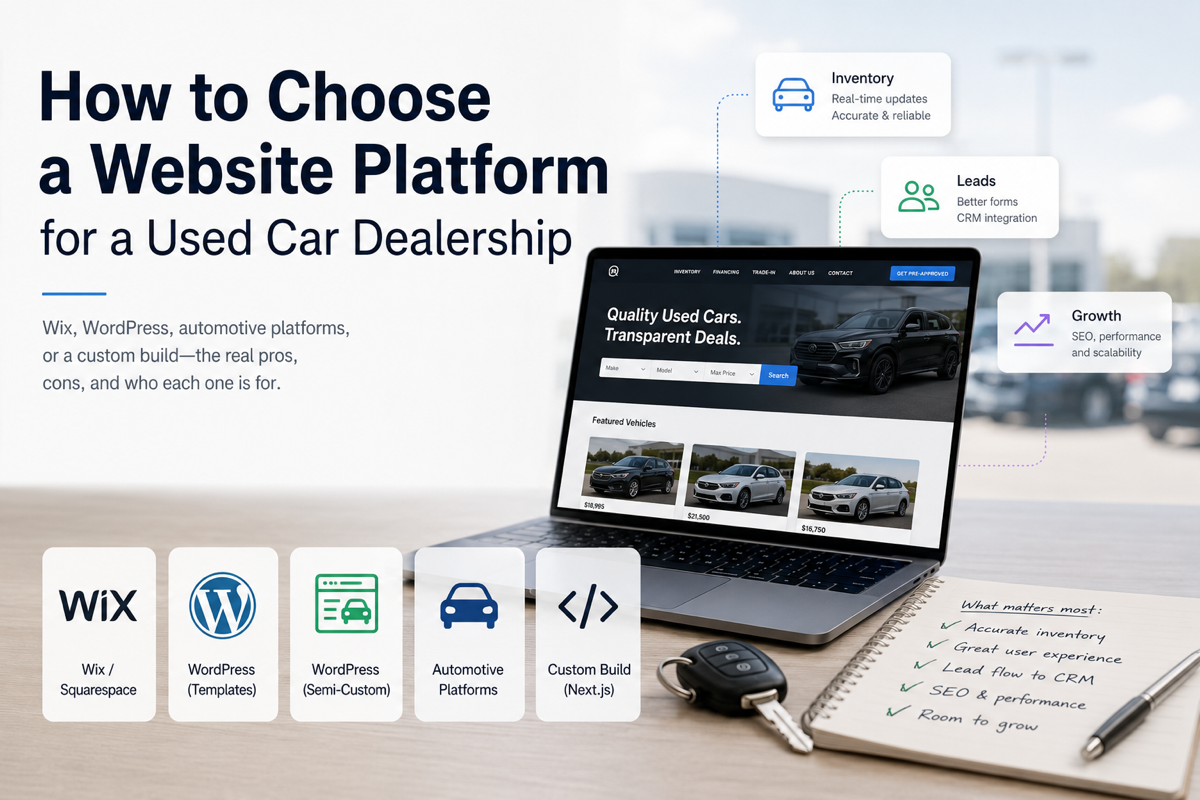
A dealership website is not just a homepage and a contact form. It has to show accurate inventory, help buyers find the right car, make vehicle pages easy to understand, and send leads into the CRM with the right vehicle and source context.
If the inventory is outdated, the search experience is poor, or leads enter the CRM without useful information, the platform choice does not matter much. The site will still create friction.
So the real question is not "Which platform is best?" The better question is: which platform fits the way your dealership operates now, and where you realistically want to be in the next few years?
Wix or Squarespace
Wix and Squarespace can work for a small dealership that needs a simple, clean online presence. They are quick to launch, easy to edit, and do not require much technical knowledge. Hosting, basic security, templates, and page editing are already handled for you.
For a small lot with limited inventory and a tight budget, that can be enough. The limitation is that these platforms are not built specifically for dealership operations.
If you only have a small number of vehicles and you are comfortable updating them manually, Wix or Squarespace may be fine. But once you need automated inventory feeds, many vehicle detail pages, advanced filtering, CRM lead routing, or deeper SEO control, you will probably start to feel the limits.
They are good for a simple presence. They are not ideal if the website needs to become a serious inventory and lead-generation system.
Best for: very small dealers, simple inventory, tight budgets, and owners who want to manage the website themselves.
Not ideal for: larger inventory, automated feed imports, custom CRM logic, advanced SEO, or dealerships trying to stand out with a more serious digital experience.
Template-based WordPress
WordPress is often the strongest middle-ground option for dealerships that want more control without going fully custom. It gives you ownership of your website, your content, your structure, and your SEO foundation. There are many automotive themes and plugins that can handle vehicle listings, filters, lead forms, feed imports, and content pages.
The main advantage is flexibility. You can publish content, create landing pages, optimize for search, manage forms, and customize the site much more than you can with a basic hosted builder.
The tradeoff is maintenance. WordPress needs updates, security monitoring, plugin management, performance tuning, backups, and someone who understands how the site is built. If the site depends on too many plugins, it can become slow or fragile. Inventory plugins can also break or behave unexpectedly when feed formats change, plugins update, or custom logic gets layered on top.
Template-based WordPress is not bad. It just needs to be managed properly.
Best for: small-to-mid dealerships that want more SEO control, content flexibility, and ownership, but still want to stay within a reasonable budget.
Not ideal for: dealerships that need very custom inventory logic, complex automation, multi-location rules, or a very unique buying experience.
Semi-custom WordPress
There is another WordPress option that many dealers do not think about. It sits between a template-based WordPress site and a fully custom platform.
In this setup, WordPress is not treated as a collection of plugins. It is used more as the website and admin layer. For example, vehicles can be stored as custom post types with structured ACF fields. Inventory can be pushed into WordPress by a custom backend parser from a CSV, SFTP feed, API, or another source. The dealer can still use the WordPress admin to edit descriptions, images, visibility, page content, or selected vehicle fields.
But the main inventory flow is automated and controlled by custom logic instead of relying entirely on generic inventory plugins.
This can be a very strong option for used car dealerships. You still get the benefits of WordPress: editable content, SEO flexibility, familiar admin experience, and lower cost compared to a fully custom platform. But you also get more control over the parts that matter most for a dealership: inventory structure, vehicle pages, feed logic, filtering, sold-status handling, and lead forms.
This approach works especially well when the website needs to look and feel custom, but the dealer still wants a practical admin panel for content management. It can also reduce the risk of building everything around plugin limitations.
The tradeoff is that it still requires a serious development setup. The data structure has to be planned properly. The feed parser has to be reliable. Performance, hosting, security, and WordPress maintenance still matter. But when built correctly, semi-custom WordPress can be one of the best middle-ground options — more control than a template site, without the cost and complexity of a fully custom application.
Best for: growing used car dealerships that want custom design, better UX, automated inventory, SEO flexibility, and an editable admin without going fully custom.
Not ideal for: very small lots that just need a basic site, or large dealer groups that need complex multi-system architecture and full platform control.
Automotive-specific platforms
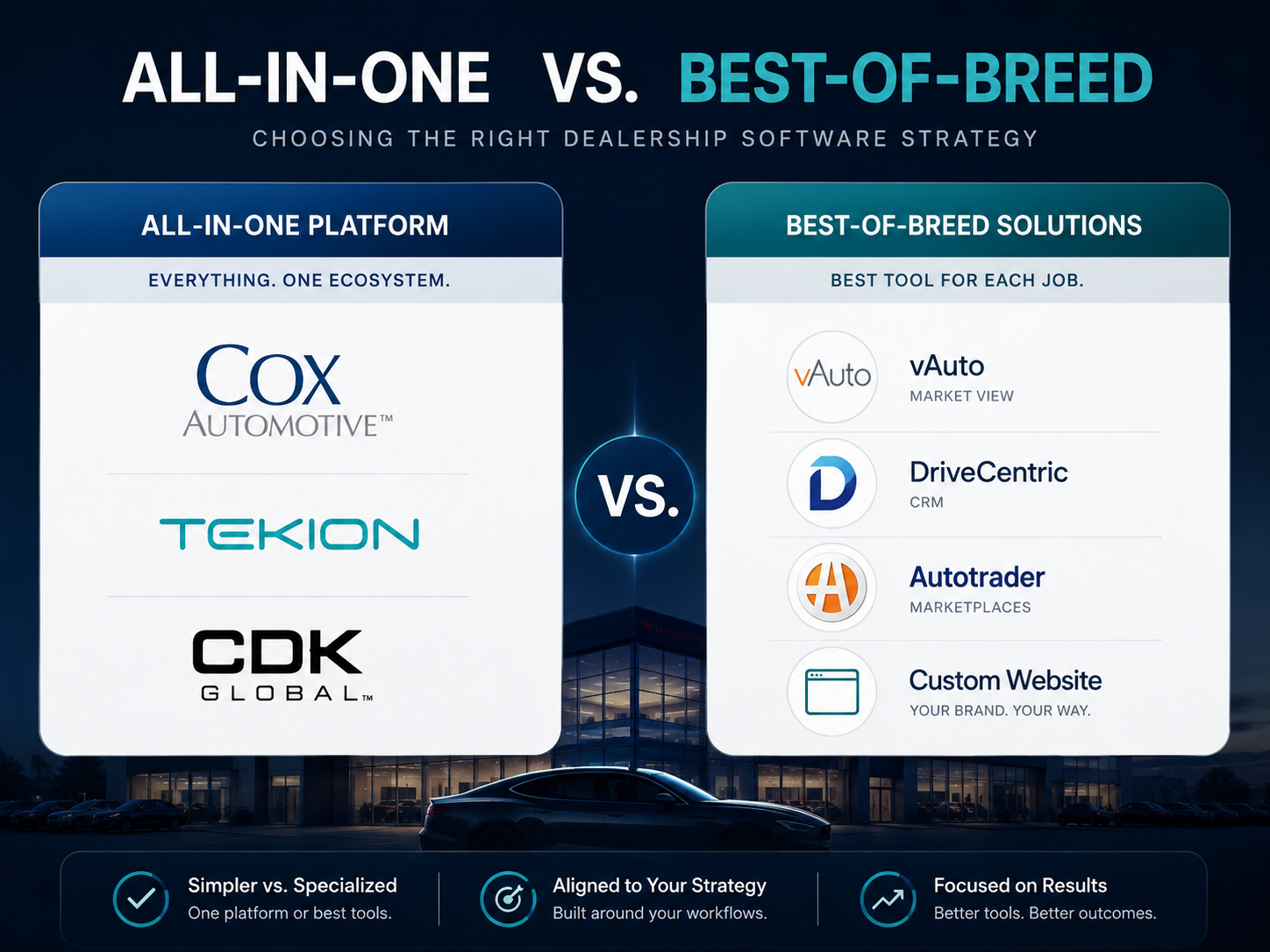
Automotive-specific platforms exist for a reason. Vendors like Dealer.com, Dealer Inspire, DealerOn, and similar providers are built around dealership needs. They often handle inventory feeds, OEM requirements, compliance, specials, lead forms, digital retail tools, and support.
For many franchise dealers, that convenience matters. If a dealer needs an OEM-approved setup, compliance support, and a mostly hands-off website solution, an automotive platform can be the practical choice.
The downside is control. These platforms are usually more template-based. You may have less freedom over the user experience, page structure, design details, performance, custom features, and brand expression.
That is why many dealer websites end up feeling similar. Same general layout. Same inventory experience. Same forms. Same patterns. For some dealers, that is fine — convenience is more important than differentiation. But for dealers that want to stand out, build a stronger brand experience, improve UX, or create custom automation around their own process, these platforms can feel limiting.
There is also the long-term cost and lock-in to consider. You may pay every month, but still not fully control the system.
Best for: franchise dealers, compliance-first stores, OEM-tied dealers, or teams that want a hands-off vendor solution.
Not ideal for: dealers that want a unique brand experience, custom UX, deeper automation, or more control over their own digital channel.
Custom build
A custom build makes sense when the website needs to become more than a standard inventory site. This could mean unique design, better inventory UX, custom search and filtering, multi-location logic, automated inventory sync, sold-status handling, CRM lead routing, or integrations with systems like vAuto, Tekion, ADF/XML lead delivery, or other internal tools.
A framework like Next.js can be a good foundation for this type of project. It can support fast vehicle detail pages, SEO-friendly rendering, image optimization, flexible frontend architecture, and clean integration with backend systems. That can be useful for dealerships with many vehicles, large image galleries, multiple stores, and more complex lead workflows.
But custom is not magic. It costs more upfront. It takes more planning. It requires a real technical partner. And it is usually overkill for a small dealer with simple needs.
The value of custom is control. You can design the inventory experience around how buyers actually search. You can make the site look different from every other dealer template. You can build the exact lead flow your sales team needs. You can connect the website to inventory and CRM systems in a way that matches your operations.
A custom build also lets the dealership create an owned digital channel instead of depending entirely on third-party platforms and rented traffic — with room to scale as you grow. But it only makes sense if the business can support it.
Best for: growing used car dealers, luxury or specialty dealers, multi-location groups, and dealerships that want custom UX, automation, brand differentiation, and room to scale.
Not ideal for: tiny lots, very limited budgets, or dealers that only need a simple online presence.
A simple way to decide
| Dealership situation | Best fit |
|---|---|
| Small lot, minimal budget, simple online presence | Wix or Squarespace |
| Small-to-mid dealer, wants SEO and ownership, okay with plugins | Template-based WordPress |
| Growing dealer, wants custom UX and automated inventory with an editable admin | Semi-custom WordPress |
| Franchise or compliance-first dealer, wants vendor support and convenience | Automotive-specific platform |
| Multi-location, complex logic, serious automation, full control | Custom build |
Final thought
There is no universal best website platform for a used car dealership. The right choice depends on your size, budget, inventory process, team, and growth plans.
If you only need a simple presence, do not overbuild. If you want more SEO and ownership, WordPress can be a strong option. If you want automation and custom control without going fully custom, semi-custom WordPress can be a smart middle ground. If compliance and convenience matter most, an automotive platform may be the safest choice. If the website needs to become a real sales infrastructure layer — with custom UX, automated inventory, CRM lead flow, and multi-location logic — then a custom build may be worth it.
The important thing is to choose based on how your dealership actually operates, not based on what platform is trendy. A good dealership website should do three things well:
- It should make the dealership stand out.
- It should make the buying experience easier.
- It should work automatically behind the scenes, so inventory, vehicle pages, forms, and CRM lead flow are not held together manually.
Not sure which fits your dealership? Tell us about your setup and we will help you choose.