

Key takeaway
As of July 21, 2026, the headline is not a crash but a slow normalization. Prices are steady to firm, inventory is adequate in total, and the market is quietly splitting into a fast lane and a slow lane. The single biggest shift is in the buyer: shoppers are increasingly choosing an acceptable monthly payment rather than simply a car.
1. Wholesale prices are easing at auction, but retail is still climbing
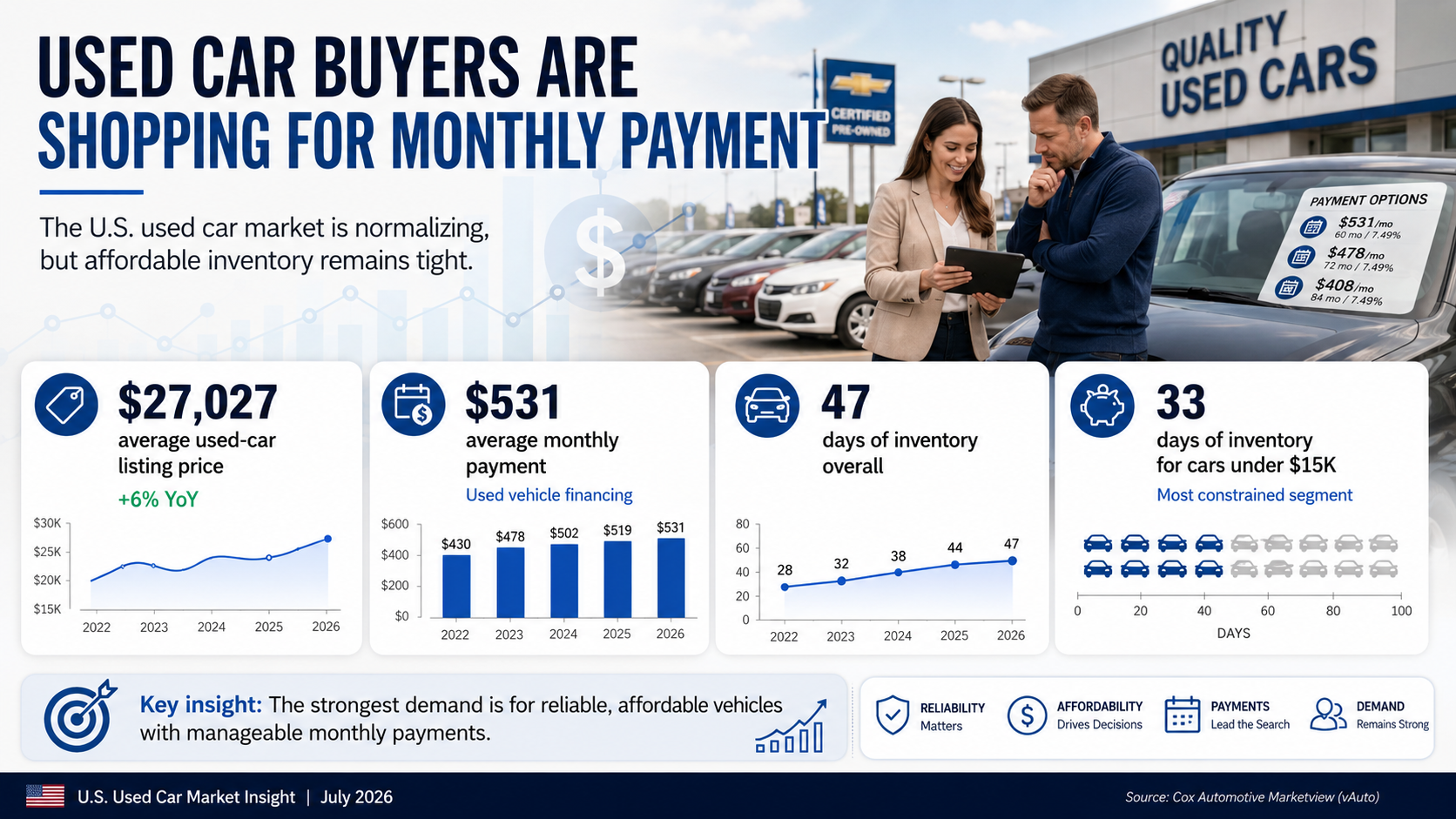
In the first half of July, wholesale prices fell 0.6% versus June, though they remain about 2% above July 2025. Retail moved the other way: the average used listing price reached $27,027 in June, up 6% year over year, and topped $27,000 for the first time since the summer of 2023.
The reason for the split is timing. Dealers are still selling cars they bought during the spring run-up in wholesale costs. So over the next few months, expect more price drops on units that have sat 45 to 60 days.
That makes a few operational capabilities critical right now:
- Automatic tracking of aging inventory.
- Comparing each unit's purchase price against its current market value.
- Fast, disciplined price adjustments.
- Separate rules for 15, 30, 45, and 60 days on the lot.
2. The real shortage is affordable cars, not luxury
Overall used-vehicle supply sat at 47 days, but for cars priced under $15,000 it was just 33 days. Cox Automotive also notes firmer wholesale prices on older, affordable vehicles, as buyers try to offset high prices and rising costs elsewhere.
The implication: the most liquid product is no longer necessarily the near-new car. It is a reliable vehicle with a clean history that can be sold with a modest down payment and a manageable monthly payment.
For mass-market dealers, that shifts the main competitive edge from advertising toward vehicle acquisition:
- A working "Sell Your Car" flow.
- Instant trade-in estimates.
- Buying cars directly from owners.
- Automated VIN-based valuation.
- Fast reconditioning and publishing.
3. More 2-to-4-year-old cars are coming in the second half of 2026
Edmunds projects that off-lease volume will grow 25.7% in 2026, nearly 500,000 more vehicles than in 2025. Meanwhile, the average price of a three-year-old car in Q1 was about $31,548, and its residual value slipped to a five-year low: 66% of the original MSRP.
This is not a price collapse. It is a gradual return of quality late-model inventory. For dealers positioned in the premium and near-new segment, it opens a useful window for 2022 to 2024 model years, lease returns, CPO and CPO-like programs, and trade-ins with full service history. CPO sales in June were already up 5% year over year and made up 15.3% of all retail used sales.
4. The buyer's problem is financing, not the sticker price
Average used-vehicle financing looked like this in Q1 2026:
| Metric | Value |
|---|---|
| Average APR | 11.43% |
| Average monthly payment | $531 |
| Average loan amount | $27,070 |
| Average term | 67.73 months |
| Average credit score | 682 |
The subprime share of used-vehicle financing rose from 19.36% to 20.60%, and 30- and 60-day delinquencies ticked up as well. Negative equity is climbing too: in Q2 2026, 29.6% of trade-ins on new-vehicle purchases were underwater, with an average amount owed above the car's value of $6,884.
The behavioral consequence is clear: a vehicle detail page that shows only $39,900 is no longer enough. Buyers need to see the estimated monthly payment, down-payment scenarios, trade-in value, payoff balance, any likely negative equity, available financing, and an approximate rate without a hard credit pull. In the luxury segment this matters even more, because even affluent buyers often decide on the structure of the financing rather than the full price.
5. Used EVs: a small but very much alive market
In June, used EV sales were 20.3% higher than a year earlier, though their share is still only 2.4% of the used market. Days' supply was 38 days, below ICE inventory, and the average used-EV listing price reached $38,342, up 7% year over year. By mid-July, the wholesale EV index was already 12.4% above a year ago, versus just 1.1% for non-EVs.
The old line that "nobody wants used EVs" no longer matches the market. The demand is there; what the buyer lacks is trust. An EV detail page should show, separately: battery health or state of health, real-world range, charging standard, charging speed, battery warranty, estimated charging cost, fast-charge history where available, and the cost difference versus a comparable ICE vehicle. In this segment, a battery report can matter more than a standard 150-point inspection.
6. The market is becoming two-speed
Holding up best: compact cars, affordable older vehicles, part of the EV segment, economical models, and cars with a low monthly payment. Performing worse: some SUVs and pickups, especially higher-priced units with high mileage or expensive financing. Cox recorded that compact cars and EVs show stronger year-over-year momentum, while SUVs and pickups fell year over year on the wholesale market.
That means a single "average used-car price" describes the real market less and less. It needs to be analyzed separately by brand, model, body type, model year, mileage, price band, fuel type, and geographic market.
What this means for dealers
In this market, the most valuable layer is not the website itself, but the inventory intelligence behind it: pricing, availability, and status change quickly, and the site has to keep up. The practical building blocks look like this:
- Inventory aging engine. Automatically flags 15/30/45/60+ days, recommends a price adjustment, and surfaces at-risk units to the manager.
- Payment-first merchandising. Filters not only by price but by monthly payment (
$500/mo,$750/mo), down payment, and credit tier. - Trade-in and negative-equity flow. The shopper enters VIN, mileage, and payoff amount and gets a realistic trade scenario.
- Automated market badges. Good Price, Recently Reduced, Low Mileage, High Demand, Rare Specification, driven by data rules rather than manual tagging.
- Dealer-owned acquisition funnel. "Sell Your Car" becomes a real sourcing system, not just a lead-capture form.
- EV trust layer. Battery report, warranty, charging, and estimated ownership costs, right on the VDP.
The strongest opportunity here is not another dealership website. It is a module that unifies the inventory feed and DMS with aging, pricing, trade-in, negative equity, and automated on-site merchandising. Feeds keep the catalog correct; webhooks close the gap between "booked" and "still online."
Sources
- Cox Automotive, Manheim Used Vehicle Value Index (mid-July 2026): wholesale down 0.6% vs June, about 2% above July 2025; mid-July wholesale EV index +12.4% YoY vs +1.1% for non-EVs; compacts and EVs stronger YoY, SUVs and pickups down YoY.
- Cox Automotive, Used-Vehicle Supply (June 2026): 47 days' supply overall, 33 days under $15,000; average used listing price $27,027 (+6% YoY); CPO sales +5% YoY and 15.3% of retail used sales.
- Edmunds, Q1 2026 Used Car Report: off-lease volume projected +25.7% in 2026 (~500k more units); average three-year-old car ~$31,548; residual value at a five-year low of 66% of original MSRP.
- Experian, State of the Automotive Finance Market (Q1 2026): average used APR 11.43%, payment $531, loan $27,070, term 67.73 months, credit score 682; subprime share of used financing 19.36% to 20.60%.
- Edmunds, Q2 2026 Negative-Equity Report: 29.6% of new-vehicle trade-ins underwater, average amount owed above value $6,884.
- Cox Automotive, EV Market Monitor (June 2026): used EV sales +20.3% YoY, 2.4% of the used market, 38 days' supply, average listing price $38,342 (+7% YoY).
Last updated: July 21, 2026.