Most dealership websites have the same hidden problem: the inventory page looks live, but it is not always operationally live.
A vehicle can still appear on the website after someone has already submitted interest, spoken with the dealership, and moved forward with the car. For the next customer, that creates a bad experience. They find the car, open the listing, send a request, and only later hear that the vehicle is no longer available.
For the dealership, it is worse. The team spends time following up on leads for vehicles that should not have been available online in the first place.
This is the problem we wanted to solve.
The setup
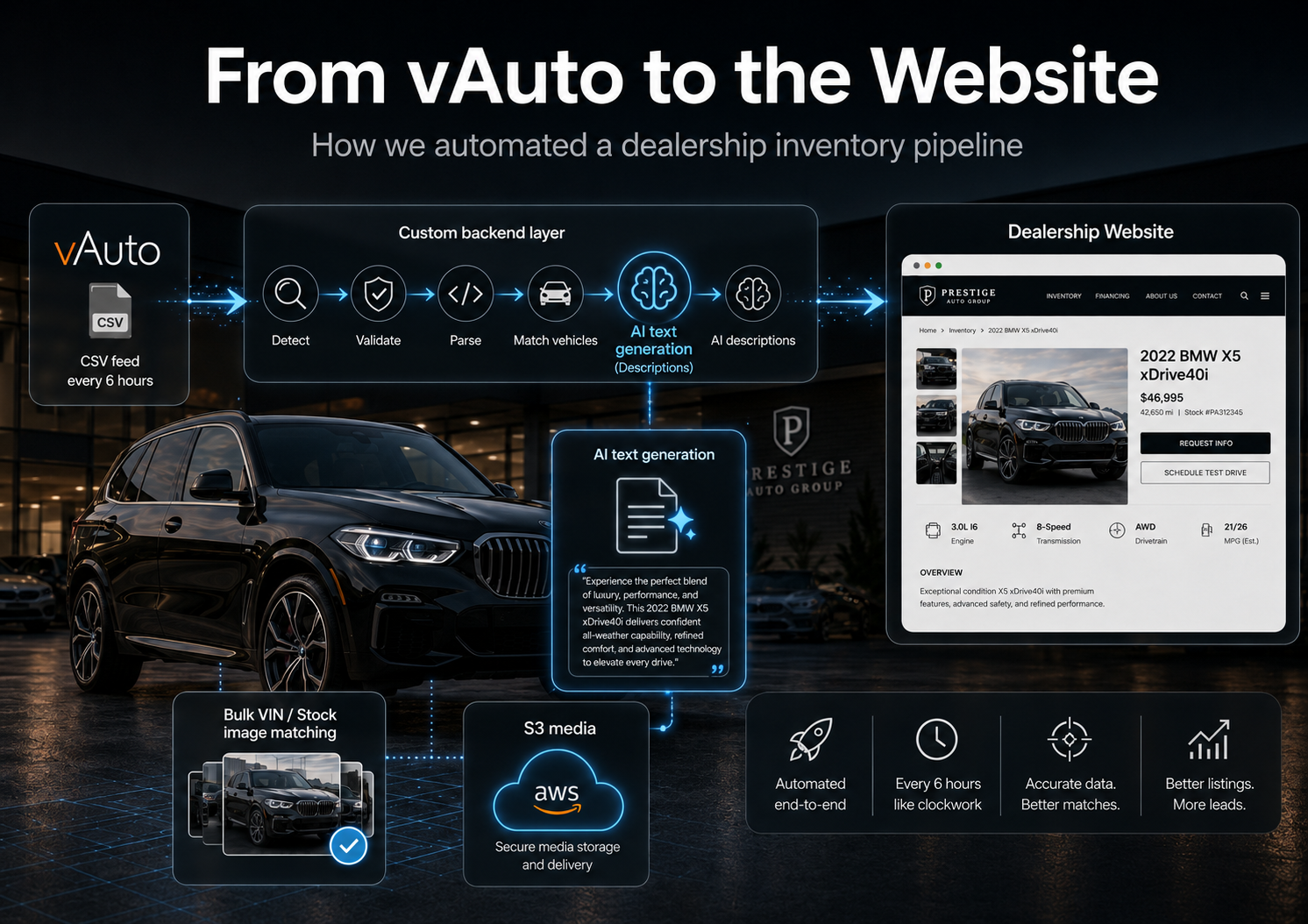
For this dealership project, the website is not managed manually. Inventory comes from vAuto through feed files. Tekion is used on the CRM / dealership operations side. Between them, we built a backend application that keeps the website inventory updated.
The backend receives the vAuto feed, parses the CSV data, reads vehicle details, checks status, maps equipment and features, and then creates or updates vehicle listings inside the WordPress database.
That means the website can automatically show new vehicles, update existing ones, refresh prices, display photos, and keep the vehicle detail pages connected to the dealership's actual inventory source.
But inventory sync alone does not fully solve the problem. A feed update may happen several times a day, but customer interest happens in real time. If a customer submits a request on a specific vehicle and the dealership later books that vehicle, waiting for the next feed is not good enough.
The vehicle needs to come off the website as soon as the dealership marks it as booked.
The full flow
Here is the workflow we built:
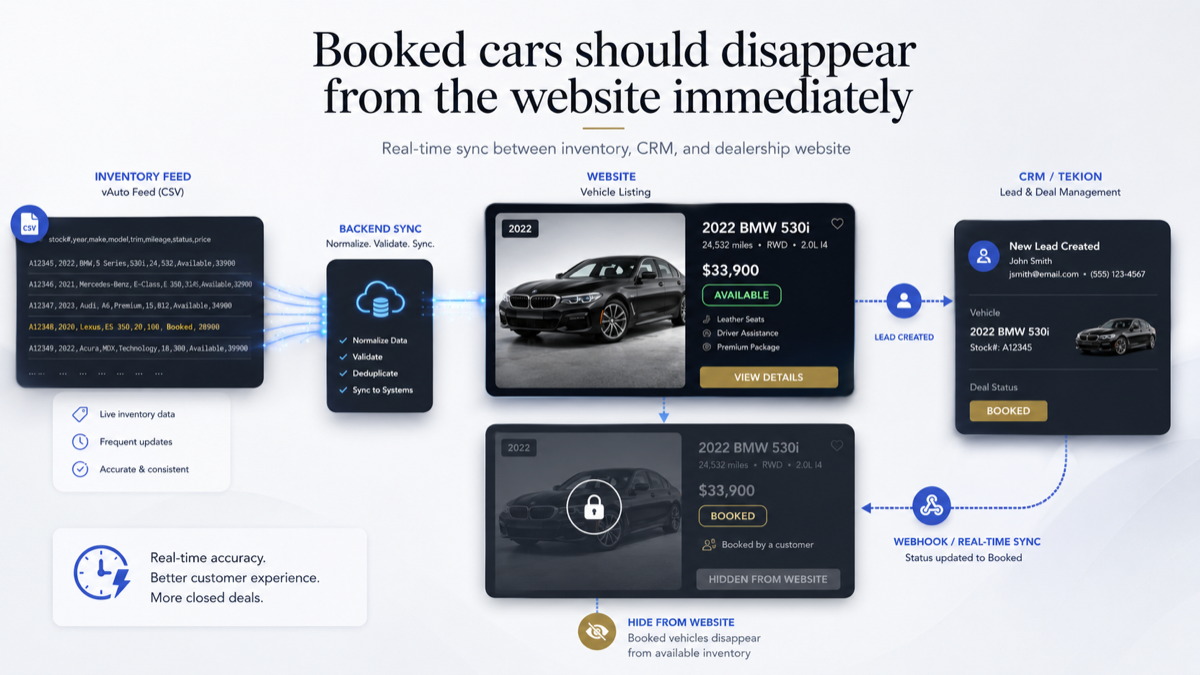
- A customer opens a vehicle detail page on the website.
- They submit a form — for example to request more information, schedule a test drive, or show purchase interest.
- The website sends the lead to Tekion with the customer details and vehicle context, including the relevant VIN / stock number.
- A new lead appears inside Tekion, so the dealership team can follow up from their normal CRM workflow.
- If the conversation moves forward and the customer wants to reserve the vehicle, the operator marks the vehicle as booked in Tekion.
- That status change triggers a webhook.
- Our backend receives the webhook, identifies the vehicle, updates the website database, and removes the vehicle from public inventory.
From that moment, the car no longer appears as available on the website.
Why this matters
This is the difference between a website that only displays inventory and a website that participates in the dealership's sales workflow.
For a used car dealership, inventory accuracy is not a small UX detail. It directly affects trust, lead quality, and team efficiency. When unavailable vehicles remain online, the dealership creates unnecessary friction:
- customers ask about cars they cannot buy;
- sales teams waste time on dead-end conversations;
- lead quality looks worse than it actually is;
- customers may assume the website is outdated;
- the dealership risks losing serious buyers to faster competitors.
Removing booked vehicles immediately helps prevent that. It keeps the website closer to the real operational state of the dealership.
Feeds are good, but they are not enough
Inventory feeds are still important. They are the foundation for keeping the website updated at scale. A proper feed sync can handle:
- new vehicles;
- price updates;
- photo galleries;
- equipment and features;
- mileage changes;
- status updates;
- dealer location mapping;
- sold or hidden inventory rules.
But feeds are usually batch-based. They update on a schedule. That is fine for many inventory changes, but not for moments where timing matters. A booked vehicle is one of those moments. Once a vehicle is reserved, the website should not wait for the next scheduled import. It should react immediately. That is where webhooks become valuable.
The better architecture
The stronger approach is to combine both systems, each with a clear responsibility:
vAuto feed → website inventory sync. Used for structured inventory updates, vehicle creation, pricing, photos, features, and regular data refreshes.
Website forms → Tekion lead creation. Used to send customer interest directly into the dealership's CRM workflow with full vehicle context.
Tekion webhook → website availability update. Used to remove or hide a vehicle immediately when its operational status changes.
The feed keeps the catalog updated. The form creates a real CRM lead. The webhook closes the availability gap. Together, they create a much more reliable dealership website.
The practical result
The dealership does not need to manually remove vehicles from the website after every serious lead. The customer does not see vehicles that are already moving through the booking process. The sales team gets leads in the CRM with the right vehicle context.
The website becomes more than a static marketing layer. It becomes connected to the actual dealership workflow — which is the direction modern dealership websites need to move in. Not just better design. Not just faster pages. Not just inventory feeds.
The real value comes when the website, inventory system, and CRM work together. Because for a dealership, an accurate website is not only about looking professional — it is about not wasting the next buyer's time.
Want your website wired into your inventory and CRM like this? Tell us about your setup and we will map it out.