Both platforms can help a dealership source, appraise, price, merchandise, and move used inventory. The more important question is not which one has the longer feature list. It is which operating model fits the way your dealership actually works.
For franchise groups and larger independent dealers evaluating used-car inventory platforms, vAuto and ACV MAX are two names likely to come up.
vAuto is one of the most established inventory platforms in the market and sits inside the broader Cox Automotive ecosystem. ACV MAX has a different history. ACV acquired MAX Digital in July 2021 and has since expanded the product significantly, including a major 2026 push to bring ACV's inspection, valuation, sourcing, pricing, and inventory intelligence capabilities closer together.
On paper, the platforms increasingly overlap. Both can support appraisal, acquisition, pricing, inventory management, merchandising, syndication, and multi-store operations. That makes a simple feature checklist less useful than it used to be.
The better question is operational: where does each platform get its intelligence, how does it fit into the rest of your dealership stack, and which parts of your current process can it actually simplify?
The core contrast: ecosystem depth vs integration flexibility
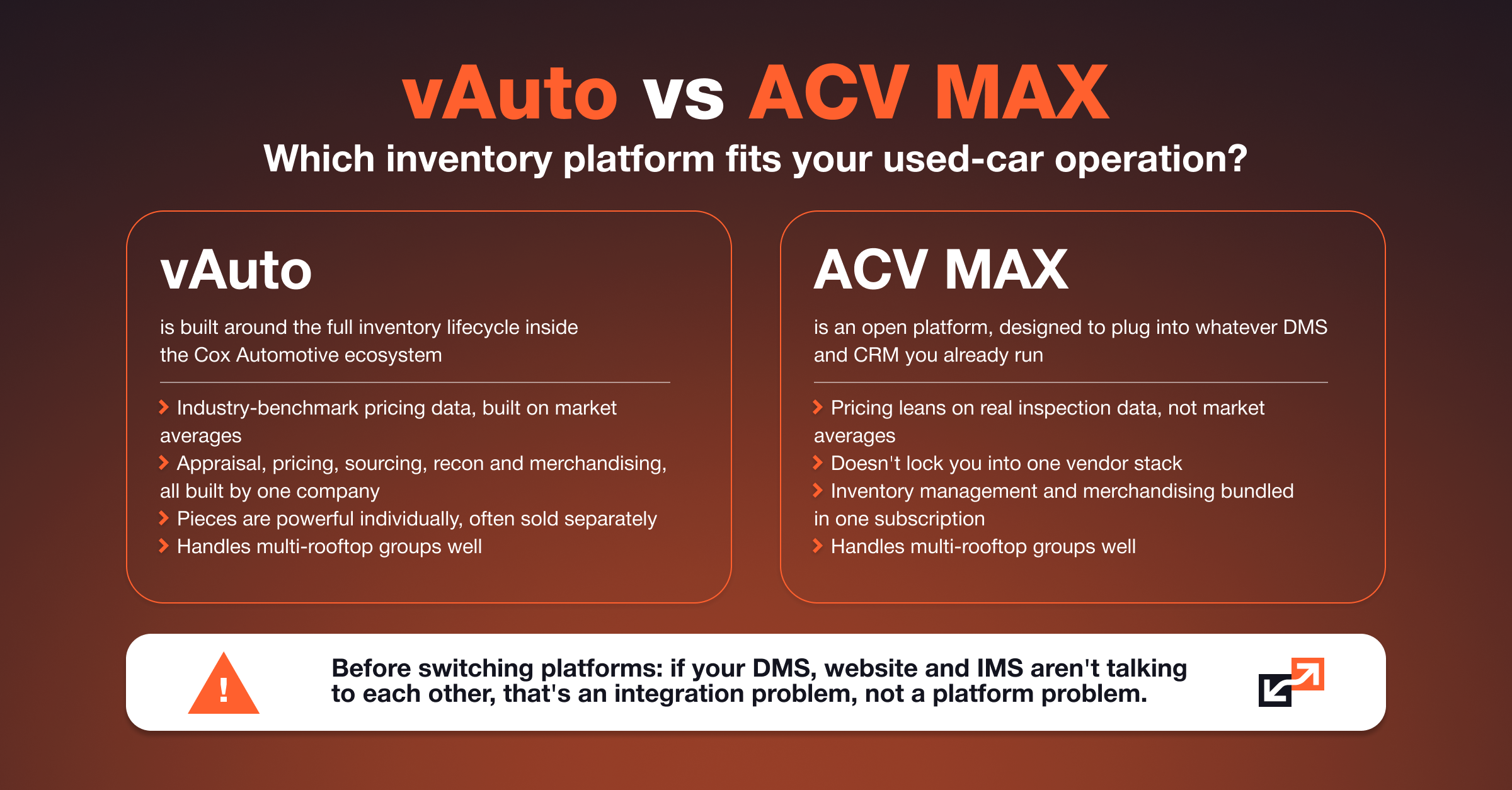
The biggest difference is not that one platform is "closed" and the other is "open." That would be too simplistic.
vAuto's strength is the depth of its connections across its own product suite and the wider Cox Automotive ecosystem. Provision connects inventory management with tools such as Stockwave for wholesale sourcing, iRecon for reconditioning, ProfitTime GPS for inventory investment and pricing strategy, and vAuto's merchandising capabilities. For a dealership already using several Cox Automotive products, that can be a meaningful advantage: inventory decisions do not have to live in isolation from acquisition, CRM activity, reconditioning, merchandising, or wholesale. But vAuto is not limited exclusively to Cox systems. Its enterprise environment can also work with data from third-party dealership systems.
ACV MAX makes integration flexibility a more explicit part of its positioning. ACV describes MAX as an open platform designed to work across dealership systems, including DMS, CRM, websites, inventory providers, pricing tools, vehicle history providers, and auction platforms.
That difference matters more than whether both products have an appraisal screen.
Here is where the emphasis differs across the inventory lifecycle. Note that both platforms cover most of these areas, so this is about emphasis, not a yes/no checklist:
| Dimension | vAuto emphasis | ACV MAX emphasis |
|---|---|---|
| Fit model | Depth inside the Cox Automotive ecosystem | Flexibility across a mixed-vendor stack |
| Acquisition and appraisal | Provision plus Stockwave wholesale breadth, ProfitTime GPS investment scoring | Market signals plus VIN-level and inspection-backed intelligence |
| Pricing and aging | Investment-potential tiers (Platinum to Bronze) | Predictive, VIN-level price and inventory recommendations |
| Reconditioning | Dedicated iRecon workflow | Broad inventory intelligence, inspection reduces condition uncertainty |
| Merchandising | Photography, 360, feature overlays, syndication | Descriptions from vehicle and OEM data, listing distribution |
| Multi-location | Provision Enterprise, cross-store transfers | Group sourcing, redistribution recommendations |
Acquisition and appraisal
vAuto's Provision platform uses live market information to support stocking, appraising, pricing, and listing decisions. Stockwave extends the acquisition side into wholesale, giving dealers access to inventory across hundreds of marketplaces and auctions from one sourcing environment. For a dealership with a significant auction acquisition operation, that breadth matters.
ProfitTime GPS adds another layer. Instead of applying the same turn strategy to every vehicle, it uses market demand, vehicle condition, dealer performance history, and other signals to estimate the investment potential of an individual unit and guide acquisition and pricing decisions.
ACV MAX approaches the same problem from a somewhat different data foundation. Its platform combines traditional market signals with dealership-specific performance and VIN-level information. Its pricing and inventory intelligence can incorporate signals such as:
The 2026 expansion added even more emphasis on vehicle-specific intelligence. ACV MAX Recommendations uses real-time signals, dealership performance, and inspection-backed data to generate VIN-specific inventory guidance. ACV has also connected MAX more closely with products such as ClearCar, ACV Guarantees, and its vehicle inspection technology.
So it would be inaccurate to describe the difference as: vAuto uses market data while ACV MAX uses vehicle data. Both use market data. The more useful distinction is that ACV is increasingly making its inspection network, condition data, and VIN-level intelligence part of the core MAX value proposition.
Pricing and aging inventory
Both platforms are trying to solve one of the hardest used-car problems: when should you hold margin, when should you reprice, and when should you get out of a vehicle?
vAuto has spent years developing its approach around inventory investment potential. ProfitTime GPS uses real-time market information and proprietary data science to guide acquisition and pricing. Its Platinum, Gold, Silver, and Bronze classifications are designed to distinguish vehicles with different profit and turn potential rather than applying the same aging policy across the entire lot.
ACV MAX is pushing toward predictive VIN-level pricing and inventory recommendations. Instead of looking only at broad comparable-vehicle averages, its models can incorporate market analytics, sales history, industry pricing trends, consumer demand, dealership-specific performance, and information associated with the VIN.
Neither approach eliminates the need for a used-car manager. The value is in giving that manager a better signal earlier, before an expensive acquisition becomes a 70-day problem.
Reconditioning
This is an area where vAuto has a clearly defined dedicated workflow. iRecon connects reconditioning with the broader vAuto inventory environment. Vehicles can move into the recon workflow after acquisition, while inventory information helps teams prioritize which units should reach frontline-ready status first. That matters because pricing a car correctly does not help much if it spends another eight days waiting for recon.
ACV MAX's recent direction is broader inventory intelligence across acquisition, condition, pricing, and retailing. Its inspection capabilities can reduce uncertainty around the condition of a vehicle, particularly during acquisition. But dealers comparing the two platforms should evaluate the actual recon workflow in each system rather than assuming equivalent capabilities simply because both platforms cover much of the inventory lifecycle.
This is important with any inventory management system: two platforms can both show "reconditioning" on a product map and still create very different day-to-day workflows for your team.
Merchandising and syndication
Both companies are also moving beyond traditional inventory management. vAuto's merchandising tools support areas such as vehicle photography, 360-degree presentation, feature overlays, automated vehicle information, listing management, and syndication to third-party destinations. Provision itself also supports parts of the listing and merchandising workflow, so merchandising is not completely separate from inventory management.
ACV MAX similarly connects inventory management with the retail side. Its retail tools can help prepare vehicle inventory for online merchandising, generate descriptions using vehicle and OEM information, and distribute listings to dealership websites and marketing partners.
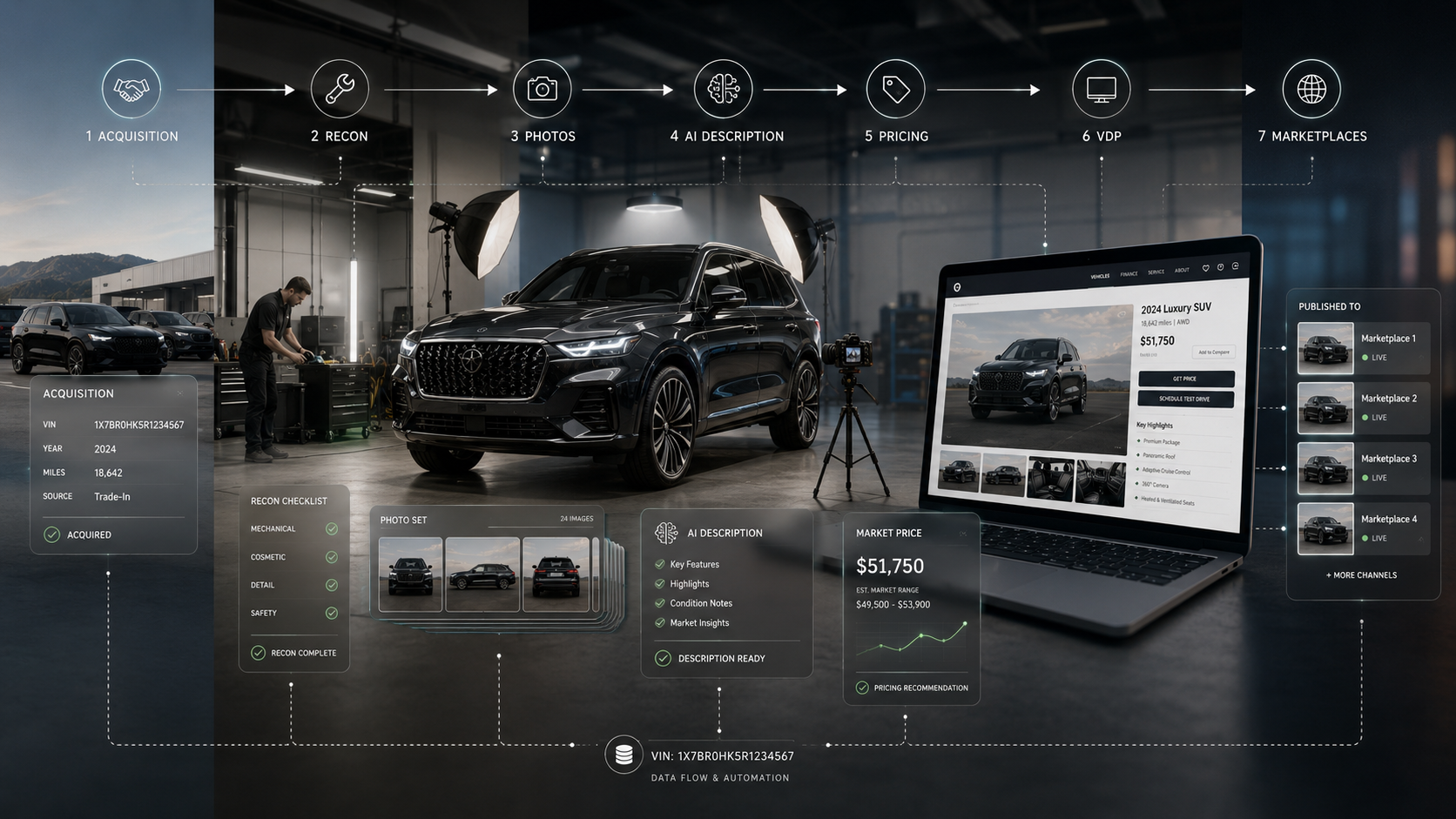
This makes the old idea of comparing an inventory management system with a separate merchandising provider less useful. Both companies are trying to reduce the number of disconnected steps between acquisition and sale:
The real question: how many of these steps still require an employee to move data by hand?
Multi-location dealer groups
Neither platform should be viewed as a single-rooftop tool. vAuto's Provision Enterprise gives dealer groups centralized visibility across locations, group-level appraisal capabilities, inventory allocation tools, and functionality for transferring vehicles between stores.
ACV MAX also supports cross-rooftop inventory strategy. Its group sourcing functionality can identify inventory opportunities across stores, recommend redistribution based on historical performance, and support inter-company transfers.
For dealer groups, that means "supports multiple rooftops" is not enough of a differentiator anymore. A better test is: how well does the system identify that a specific vehicle is sitting at the wrong rooftop, and how much work does it take your team to act on that recommendation?
So which platform fits which operation?
There is no universal winner.
vAuto is worth a close look if:
- Your dealership already uses multiple Cox Automotive products and wants inventory management deeply connected with that ecosystem.
- Wholesale sourcing is a major part of your acquisition strategy and broad auction visibility matters.
- Your used-car operation is heavily built around live-market pricing, appraisal discipline, investment-based inventory strategy, and mature recon workflows.
- You run a dealer group and want centralized inventory management, appraisal oversight, and cross-store transfer capabilities.
ACV MAX is worth a close look if:
- Your dealership operates across a mixed stack of DMS, CRM, website, auction, and data vendors, and integration flexibility is important.
- You want dealership-specific and VIN-level intelligence to play a larger role in pricing and acquisition decisions.
- Consumer acquisition and condition-based valuation are important parts of your sourcing strategy.
- You want sourcing, appraisal, pricing, merchandising, syndication, and ACV's inspection and wholesale capabilities increasingly connected through the same platform.
But before switching platforms, check whether the inventory system is actually the problem
This is the part that gets missed in a lot of software comparisons. A dealership can have one of the strongest inventory platforms available and still have a bad inventory operation.
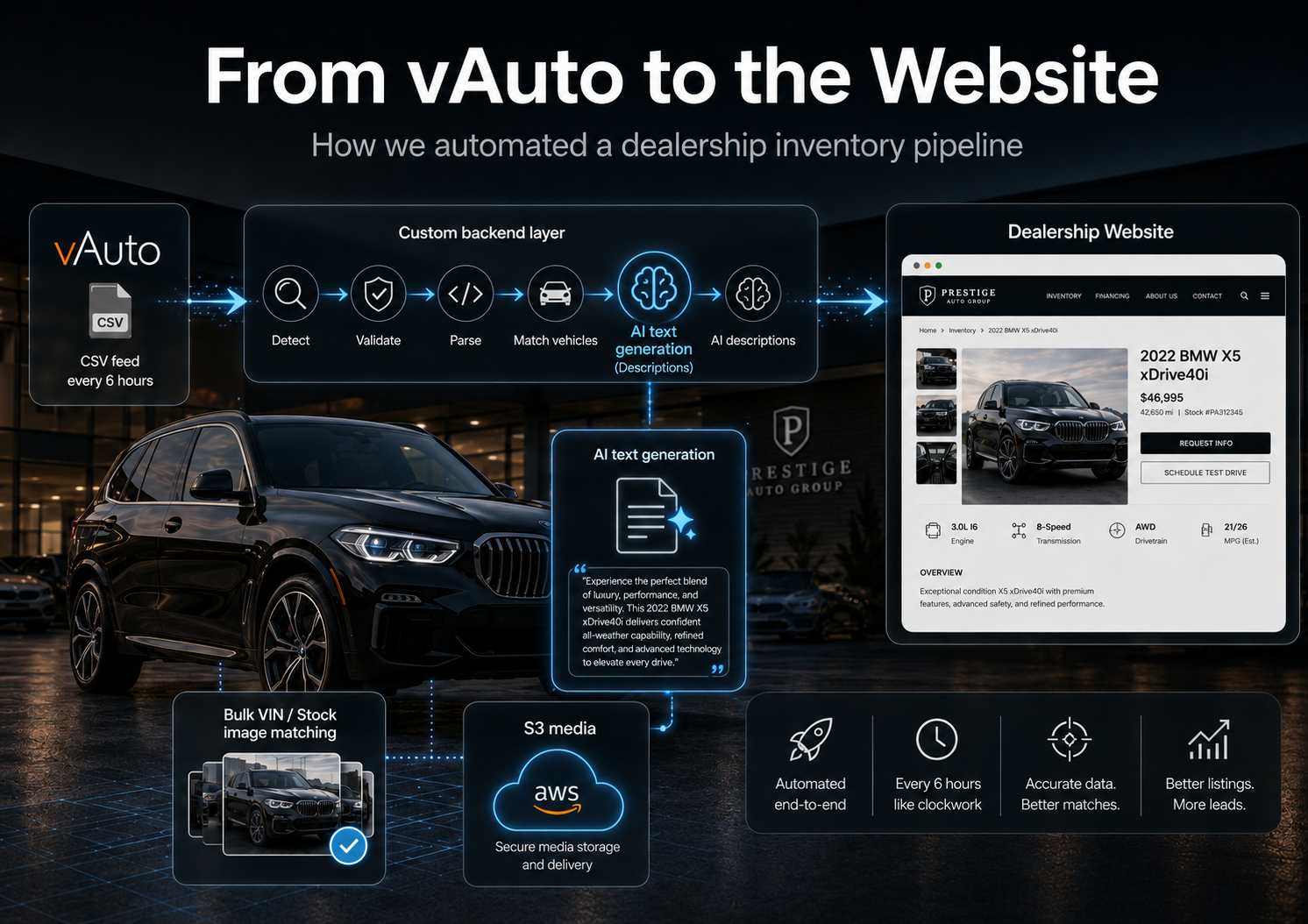
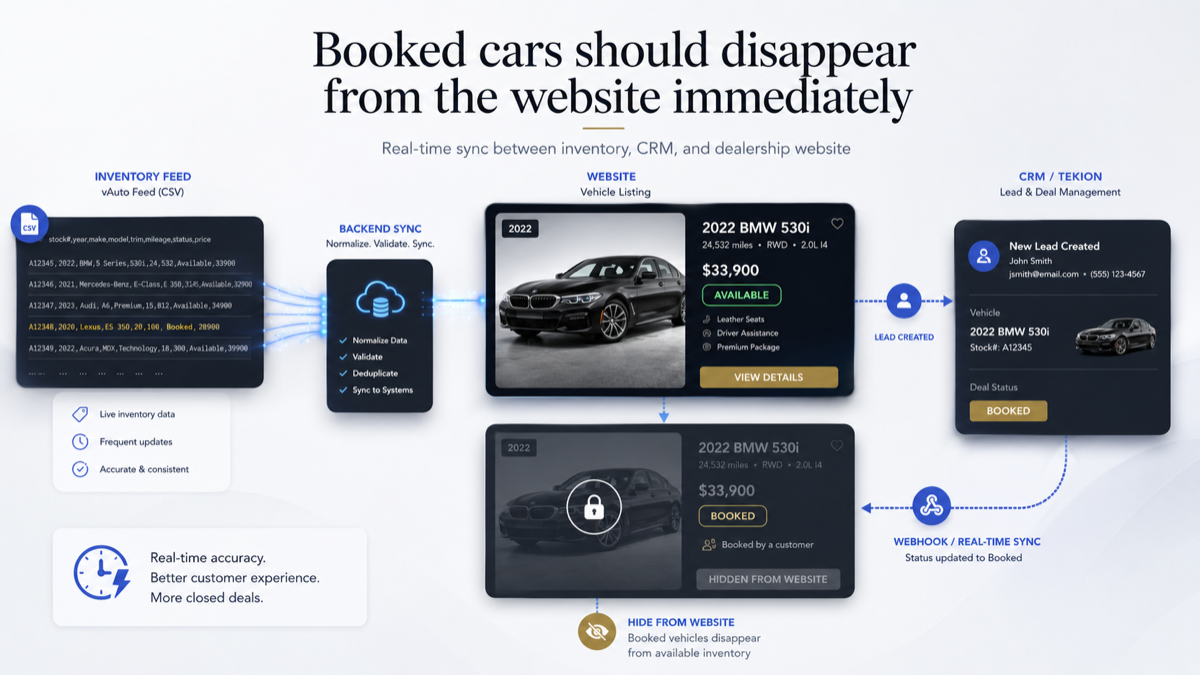
Imagine this flow: DMS, then the inventory platform, then the website, then the marketplaces. The DMS says the vehicle sold at 2:10 PM, but each system downstream picks that up on its own schedule.
From the customer's perspective, the inventory system failed. But replacing vAuto with ACV MAX, or ACV MAX with vAuto, does not automatically fix that problem. The failure may be somewhere between the systems. The same applies to a long list of familiar issues:
These problems are easy to misdiagnose because the symptom appears inside the inventory workflow. But the inventory system may be doing exactly what it was configured to do. That is usually an integration problem, not a platform problem.
The real evaluation should start with your process
Before comparing contracts, map the lifecycle of one vehicle through your dealership:
That exercise tells you much more than a product comparison matrix, because the right inventory platform can improve a good process. It cannot repair an architecture nobody has mapped. If mapping it surfaces manual steps between the systems, that is often a workflow to fix before it is a contract to switch.
The best inventory management system is not necessarily the platform with the most features. It is the platform that fits your operating model, receives the right data, sends it to the right systems, and removes work from your team instead of creating another place to manage it.
References
vAuto
- Provision: Used Car Inventory Management Software
- ProfitTime GPS: Used Car Pricing and Acquisition Insights
- Stockwave: Wholesale Vehicle Sourcing
- iRecon: Reconditioning Management
- vAuto Merchandising
- vAuto Connected Solutions
ACV MAX
- ACV MAX: Platform Overview
- ACV MAX Integrations
- ACV MAX Source
- ACV MAX Price
- ACV MAX Retail
- ACV Unveils All-in-One Inventory Intelligence Suite for Dealers (May 7, 2026)
- ACV Expands MAX Suite with ACV MAX Recommendations (March 19, 2026)
- ACV Acquires MAX Digital (July 13, 2021)
Product capabilities, integrations, packaging, and commercial terms can vary by dealership, dealer group, and contract. Dealers should confirm current availability and pricing directly with each vendor.