The common wisdom about car dealers and bad reviews goes like this: the review sits there, unanswered, forever. The unhappy customer gets the last word, and every future shopper reads the complaint with no reply underneath it.
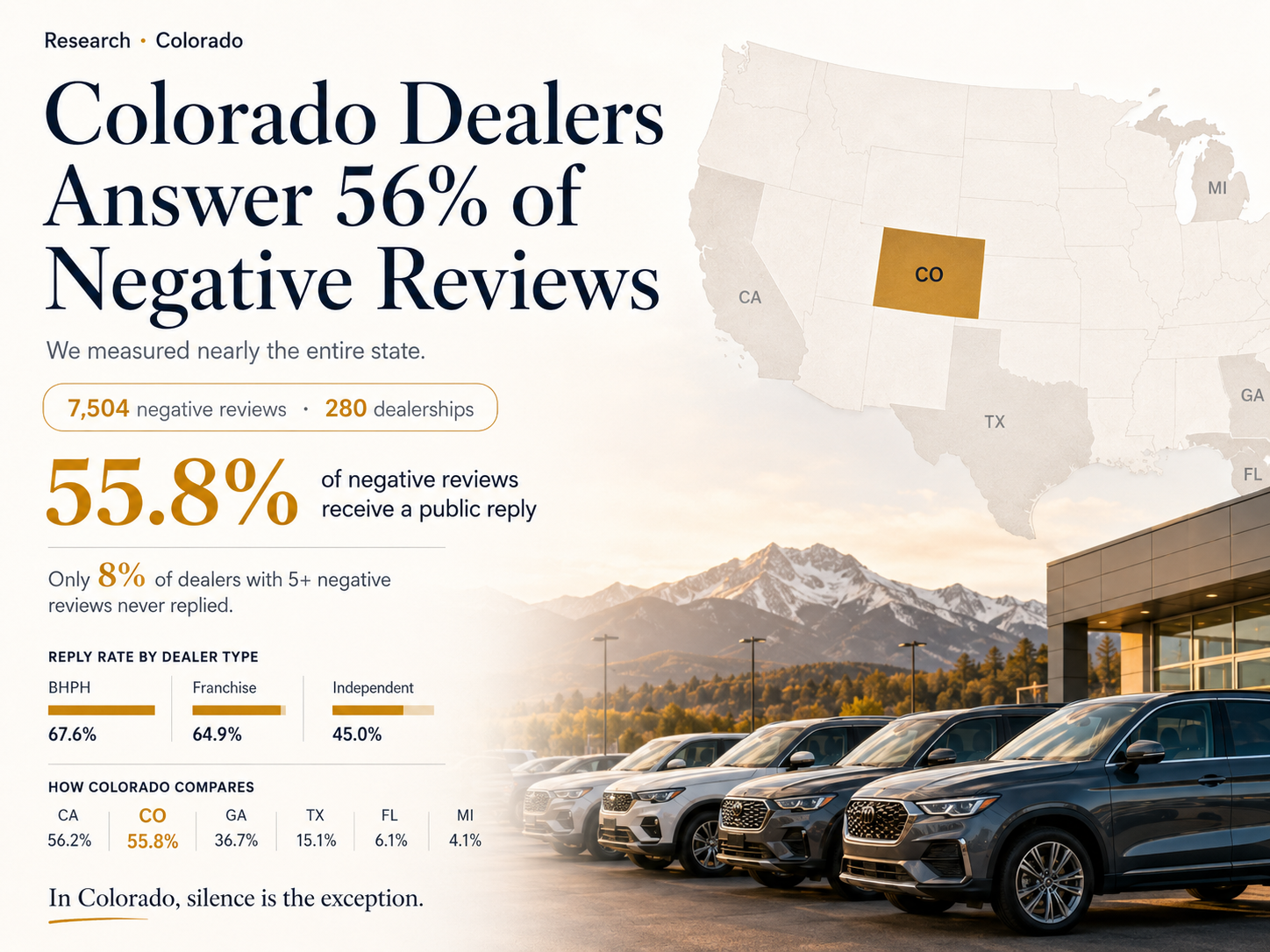
We wanted to know if that is actually true. So in August 2026 we collected every recent one-, two-, and three-star Google review we could find for Colorado's used-car dealerships in Denver, Colorado Springs, Aurora, Fort Collins, Pueblo, and the towns between them. 7,504 negative reviews across 280 dealerships.
In Colorado, the common wisdom is wrong.
More than half of negative reviews get an answer
4,188 of the 7,504 negative reviews (55.8%) have a public dealer response. Looking only at recent reviews, 2023 through 2026, the rate rises to 63.8%. On the harshest slice (one-star reviews only, same recent window), it is 61.3%.
In Colorado, an unhappy customer is more likely to hear back from the dealership than not. That alone puts the state far outside the industry stereotype.
This is not a sample. It is essentially the whole market.
Colorado's used-car market is compact enough for something unusual: a near-census. The entire state has 372 used-car dealerships with a meaningful review presence on Google. We collected from 293 of them, and negative reviews turned up at 280.
So these numbers do not describe a slice of Colorado dealers. They describe, for practical purposes, all of them.
Even the smallest lots answer
The predictable version of this story would be: big franchise stores with corporate playbooks do the answering, small independent lots stay silent. Colorado refuses to follow the script.
| Dealer class | Share of negative reviews answered |
|---|---|
| Buy-here-pay-here | 67.6% |
| Franchise stores | 64.9% |
| Independent lots | 45.0% |
Yes, franchises answer more. But Colorado's independents (the one-owner, everyone-does-everything lots) answer 45% of their negative reviews. The standard excuse in this industry writes itself: big stores have marketing staff, small lots have one person doing it all. Colorado breaks the excuse. In this market, the habit of answering reached the smallest family lot, and it answers almost every second unhappy customer.
“We're too small for this” turns out to be a habit, not a constraint.
Silence here is the exception, not the rule
A few more measurements, because the structure behind the headline number matters.
Dealers who have never replied to a single negative review (among those with five or more): 8%. A silent dealership in Colorado is one store in twelve, visible to every shopper who compares.
Copy-paste template replies (the same text from the same dealer five or more times): 0.6% of all responses. The ten most active locations produce just 13.5% of the state's replies; answering is spread across the whole market, not carried by a few champions. And the median reply runs 337 characters: a real paragraph, not a brush-off.
Put together: in Colorado, answering customers is not a differentiator anymore. It is table stakes.
What this means for a dealer
If you run a store in a market like this, the bar has moved. Answering is assumed; the competition is in what your answers are made of: how fast they come, how human they sound, and whether anyone traces the complaint back to whatever keeps producing it. Because the complaints themselves are the same ones we see everywhere: a car that was already sold on the website. A call that never came back. Paperwork that never arrived. Each of those is a process with a missing owner, and the reviews will keep writing about it until someone inside the store is assigned to notice.
And if you run a store in a market where almost nobody answers, Colorado is proof of how the other half lives. The machinery behind these numbers is boring: an alert when a review lands, a clear owner, a human reply, a monthly look at causes. Nothing about it requires a corporate budget; the 45% at Colorado's smallest lots settles that. It requires deciding to start.
The wider context
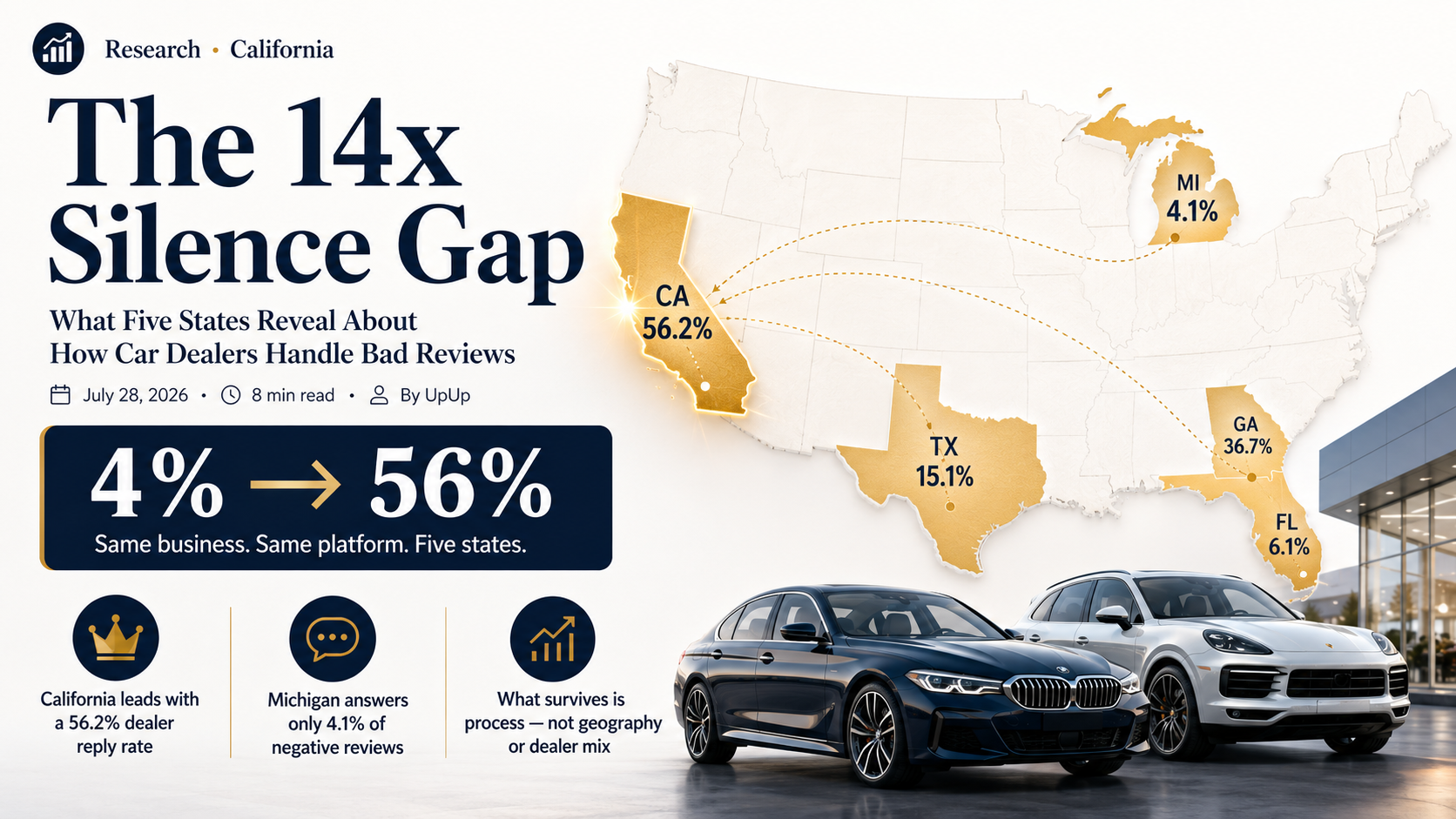
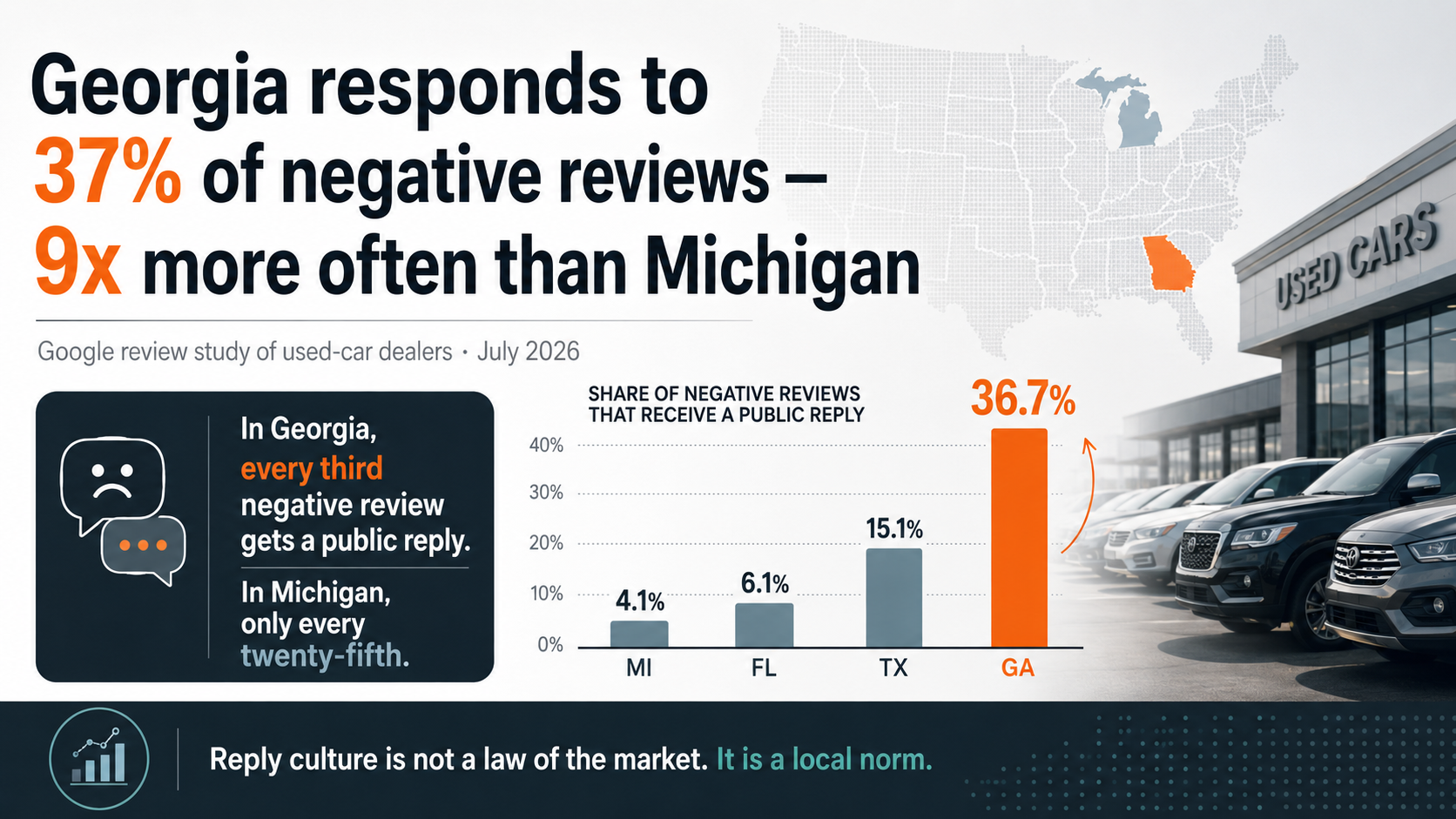
Colorado is one chapter of a study we are running across ten US states, with 80,674 negative reviews collected so far. Against that backdrop, Colorado's numbers are even more striking:
| State | Share of negative reviews answered |
|---|---|
| California | 56.2% |
| Colorado | 55.8% |
| Georgia | 36.7% |
| Texas | 15.1% |
| Florida | 6.1% |
| Michigan | 4.1% |
The spread between American markets is fourteen-fold, and it does not follow climate or dealer type. Two Western states sit at the top within half a point of each other; the industrial North sits at the bottom, where roughly nine in ten dealers have never answered anyone. What separates them, as far as every check we have run can tell, is process, which is good news, because process, unlike geography, can be built. The full study, including how Michigan's silence looks from the inside and what happened when Georgia broke the pattern, is in our research hub.
Methodology note. 7,504 public 1–3 star Google reviews of Colorado used-car dealerships, collected in August 2026. Colorado's market is small enough that the sample approaches a census: 372 dealerships statewide carry a meaningful used-car review presence, 293 were sampled, and negative reviews were found at 280. A “response” means a public owner reply visible on Google at collection time. Cross-state figures come from the same collection design and verification protocol (aligned time windows, one-star-only checks, template and concentration diagnostics) applied to a cumulative dataset of 80,674 negative reviews across six states. Response concentration is measured per location, not per chain name. Last updated: August 13, 2026.