Michigan put America on wheels. But when car buyers leave negative reviews for Michigan dealerships, the conversation is surprisingly one-sided.
We analyzed 18,116 negative Google reviews left for Michigan car dealers to understand what customers complain about, how dealers react, and where operational software could help. The first finding was simple, but hard to ignore:
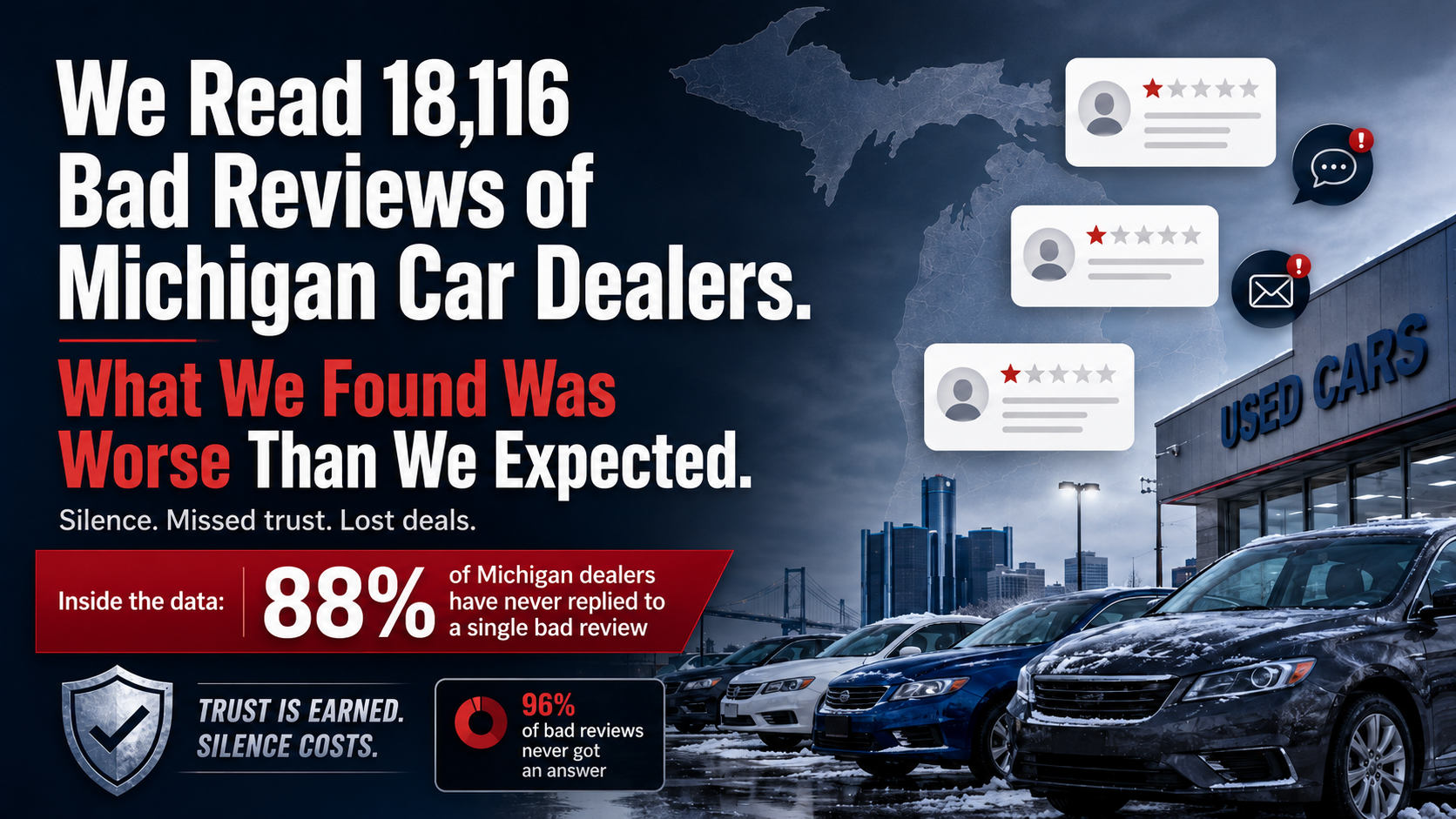
95.9% of negative reviews received no public response from the dealer.
That means the unhappy customer usually gets the last word, and every future buyer researching that dealership sees the complaint without context, explanation, apology, or follow-up.
This matters because reviews are not a small side channel anymore. BrightLocal's 2026 Local Consumer Review Survey found that 97% of consumers read reviews for local businesses, and 41% always read reviews when choosing a business. In the same survey, 31% of consumers said they will only use a business with a 4.5+ star rating.
For used car dealers, where a single purchase can involve thousands of dollars, trade-ins, financing, warranties, delivery, and post-sale trust, public reviews are part of the sales funnel.
What we analyzed
For this first study, we focused on Michigan car dealers. Our dataset included:
- 919 validated dealer locations after address validation
- 357 dealers in the research sample
- 18,116 negative reviews, defined as 1–3 star Google reviews
- Reviews from 2009–2026, with most reviews from 2019 onward
- Around 98% of reviews had enough text to be classified
A broader raw collection also showed that recent negative feedback is not slowing down. We found 2,216 negative reviews in 2023, 2,381 in 2024, 2,965 in 2025, and 1,630 in the first half of 2026. So this is not an old reputation problem. It is active.
The main finding: almost nobody replies
Out of 18,116 negative reviews, only 734 had a dealer response. That is a response rate of 4.1%. The remaining 17,382 negative reviews, or 95.9%, were left unanswered.
This does not mean every complaint was fair. Some reviews may be exaggerated, emotional, or missing important context. But from a buyer's perspective, silence still creates a problem.
A negative review says:
“This dealer ignored me.”
“They changed the price.”
“The car was not as described.”
“Nobody called me back.”
“The service was terrible.”
When there is no response, the dealership gives future customers no reason to question that version of events.
Most dealers with repeated feedback never responded once
We also looked at dealers with at least five negative reviews. Among those dealers, 226 out of 257 never replied to a single negative review. That is 88% of dealers with repeated negative feedback choosing complete silence.
This is the part that makes the finding operational, not just reputational. A one-off missed review can happen. But when a dealership has five, ten, fifty, or hundreds of negative reviews and still never replies, that usually points to the absence of a process. Not a bad response process, no response process at all.
Franchise dealers reply more often, but still rarely
Response behavior differed by dealer type:
| Dealer type | Negative reviews analyzed | Share with dealer response |
|---|---|---|
| Franchise dealers | 12,468 | 5.3% |
| Buy-here-pay-here dealers | 939 | 4.4% |
| Independent dealers | 4,709 | 0.6% |
Franchise dealers performed better than independent dealers, but even there, the response rate was only 5.3%. Independent dealers were almost completely silent: only 0.6% of their negative reviews received a reply.
When we looked at dealers with at least five negative reviews, the difference became even sharper:
| Dealer type | Never replied to any negative review |
|---|---|
| Franchise dealers | 77 of 104 · 74% |
| Buy-here-pay-here dealers | 13 of 15 · 87% |
| Independent dealers | 136 of 138 · 99% |
For independent dealers, this means nearly every dealership with recurring negative feedback had no visible response habit.
The lowest-rated dealers were completely silent
We also grouped dealers by their overall Google rating.
| Dealer rating | Negative reviews analyzed | Share with dealer response |
|---|---|---|
| 4.5+ | 8,836 | 4.9% |
| 4.0–4.4 | 8,621 | 3.5% |
| Below 4.0 | 659 | 0.0% |
The most concerning group was dealers rated below 4.0. Across 659 negative reviews, they had zero public responses.
This does not prove that replying to reviews automatically creates a higher rating. But it does suggest something practical: the dealers with the weakest reputation also appear to have the weakest visible feedback process. That is a missed opportunity.
For dealerships, that means review responses are not just reputation management. They are buyer reassurance.
Why silence is expensive for used car dealers
A negative review is not only feedback from one unhappy customer. It is also a public sales objection.
A buyer may read it before submitting a lead form. A trade-in customer may read it before booking an appointment. A finance customer may read it before trusting the store with personal information. A service customer may read it before deciding whether to come back.
BrightLocal found that after reading positive reviews, 54% of consumers visit the business's website, and 27% have spent more than $1,000 after reading reviews.
That is especially relevant in automotive. Reviews often sit directly between search intent and website traffic. A buyer searches for a dealer, reads reviews, checks inventory, and then decides whether to call, submit a form, or move on. If the review profile is full of unanswered complaints, the website has to work harder to rebuild trust.
The real problem is usually not “bad review replies”
For many dealers, the problem is not that they need better wording. The problem is that review handling is disconnected from operations.
A customer says nobody called them back. That should not only produce a public reply. It should create a lead follow-up audit.
A customer says the online inventory was wrong. That should not only produce an apology. It should trigger a check of the inventory feed, DMS sync, website cache, and sold-vehicle logic.
A customer says the price changed after they arrived. That should not only be answered. It should be classified as a pricing transparency issue and reviewed across vehicle detail pages, ads, disclaimers, and CRM notes.
A customer says nobody followed up after financing or service. That should become a workflow problem: reminders, ownership, escalation, and CRM tasks.
That is where software becomes useful.
What dealers can build from review data
Review data can show where dealership operations break down. The right system can turn public complaints into internal improvements. For example:
- Review monitoring and alerts. A dealer should know when a new 1–3 star review appears. Not next month. Not when someone randomly checks Google. The right people should get notified quickly, with a clear owner and response deadline.
- Response workflow. Dealers do not need generic copy-paste replies. BrightLocal found that generic or templated responses make 50% of consumers less likely to choose a business. A better workflow can draft a response, pull in context, assign it to a manager, and keep the final message human.
- CRM and DMS connection. If the reviewer can be matched to a lead, deal, service visit, or vehicle inquiry, the complaint should connect back to the internal record. That allows the team to see what actually happened instead of guessing.
- Complaint classification. Negative reviews can be categorized into themes: communication, pricing, financing, vehicle condition, trade-in experience, service delays, inventory accuracy, delivery, warranty, and post-sale support.
- Escalation rules. Some reviews need a public reply only. Others need a manager callback, internal investigation, or service recovery task. Software can help separate low-risk feedback from urgent cases.
- Operational reporting. Dealers should be able to see response rate, average response time, unresolved complaints, recurring issues, and which locations or departments create the most negative patterns.
- Website and inventory improvements. If reviews repeatedly mention wrong availability, missing photos, confusing pricing, or poor follow-up, that should influence the website roadmap. The best website improvements often come from real customer frustration, not assumptions.
Google also recommends responding
Google's own Business Profile guidance tells businesses to reply to reviews, value all reviews, keep responses professional, personalize replies, and respond in a timely manner. Google also notes that negative reviews can be an opportunity to understand customer expectations and improve future experiences.
That aligns with what the data shows. The issue is not whether dealers should respond. The issue is whether they have the process and tools to do it consistently.
What this means for Michigan dealers
The Michigan data suggests a large gap between customer expectations and dealership behavior. Buyers are reading reviews. They expect businesses to respond. They care about recent feedback. They notice when a business is silent. And in Michigan, most negative reviews from car buyers are still unanswered.
For dealers, the first step is not complicated:
- Track every new negative review
- Assign ownership
- Respond quickly
- Avoid generic replies
- Connect complaints to CRM, DMS, inventory, service, and sales workflows
- Use patterns in reviews to decide what to fix next
A response will not fix a broken operation by itself. But silence guarantees that only the unhappy customer's version is visible.
Why we started with review silence
This study is not only about reputation management. It is about a visible operational gap. If 95.9% of negative reviews receive no response, the issue is probably not that every dealer forgot to reply once. More likely, there is no clear process: no alert, no owner, no deadline, no connection between the public complaint and the internal CRM, sales, service, or inventory workflow. That is the kind of problem we look for in this research series.
Methodology: we collected public 1–3 star Google reviews for 357 used car dealerships across Michigan (metro Detroit, Flint, Lansing, Grand Rapids and surrounding areas) in 2026, out of a base of 919 validated locations. “Response” means a public owner reply visible on Google at collection time. Consumer-behavior figures: BrightLocal Local Consumer Review Survey (2024 and 2026). Last updated: July 8, 2026.