In part one of this study, we showed that 96% of negative reviews of Michigan dealers go unanswered, and 88% of dealers have never replied to a single one. The natural assumption was that this is simply how the used-car market works.
Georgia broke that assumption.
In July 2026 we collected 15,416 negative Google reviews (1–3 stars) across a sample of 400 Georgia used-car dealers in metro Atlanta, Macon, Savannah, Augusta, and Columbus; negative reviews turned up at 364 of them. Here are five facts from the data.
Fact 1: One in three negative reviews gets a reply
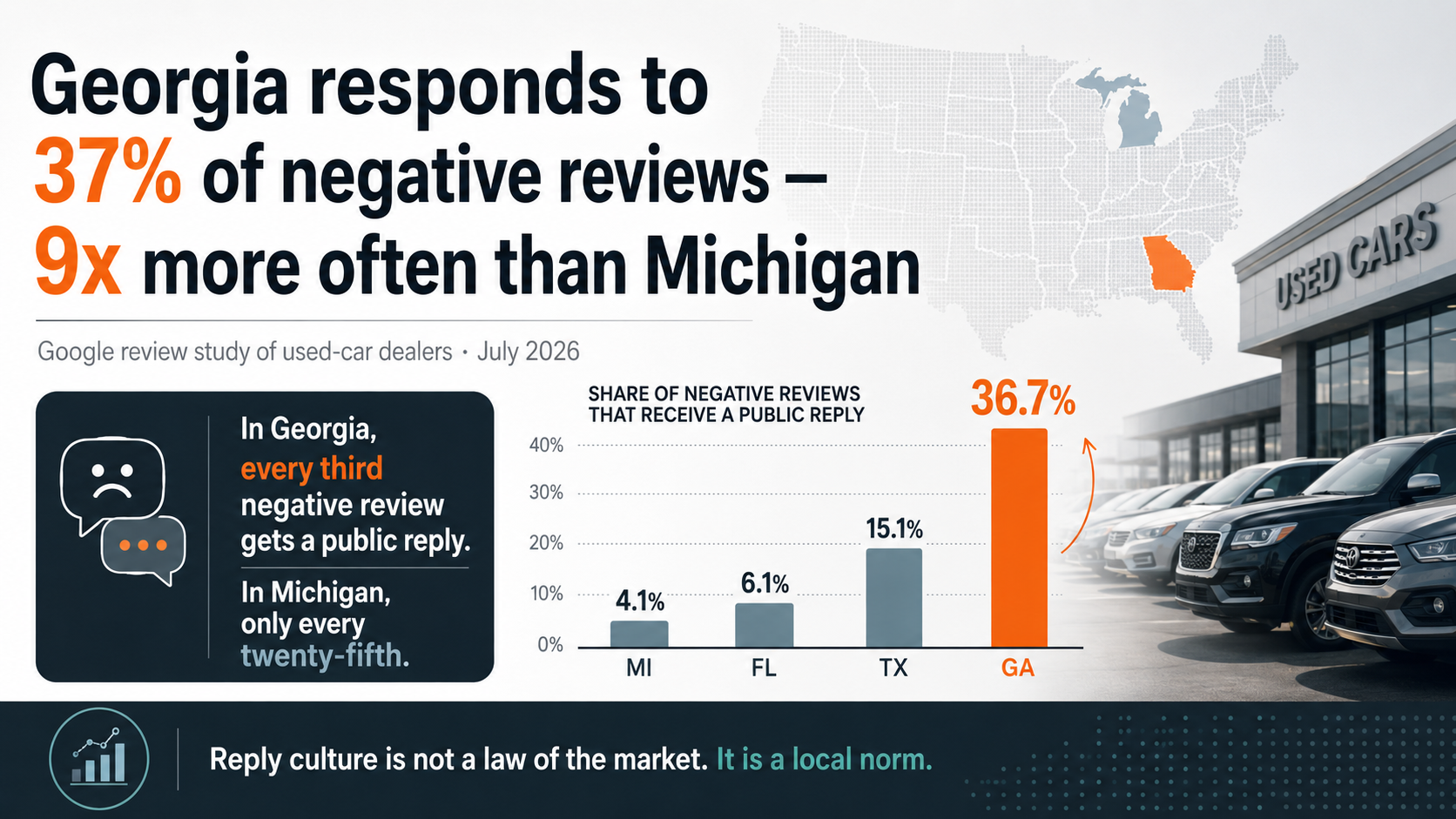
Of the 15,416 negative reviews, 5,665, or 36.7%, have a public dealer response. In Michigan, the same figure is 4.1%. That is a nine-fold difference.
Fact 2: Not a data artifact, verified five ways
A gap this large between two neighboring studies usually signals a methodology error. So before writing this article, we tried to break the number.
- Same period. On the 2023–2026 slice, the samples are almost identical in size, 8,743 reviews in Georgia against 8,714 in Michigan, and the gap holds: 38.2% versus 4.8%.
- Same star rating. Looking only at one-star reviews, it is 37.9% versus 4.7%.
- Templating. Exact duplicate responses (the same reply from the same dealer five or more times) account for only about 2% of all Georgia responses.
- Concentration. The ten most active dealers produce 11% of responses, so the effect does not rest on a handful of mega-lots.
- Quality. The median response length in Georgia is even greater than in Michigan, 334 characters versus 306.
The gap is real.
Fact 3: In Georgia, every market segment replies
It is not a few standout stores that respond, but every type of dealer:
| Market segment | Share with dealer response |
|---|---|
| Buy-here-pay-here | 52.2% |
| Franchise dealers | 44.3% |
| Independent dealers | 26.9% |
For comparison: an independent Georgia dealer replies roughly 45 times more often than an independent Michigan dealer (26.9% versus 0.6%). Georgia's quietest segment is more talkative than Michigan's loudest one.
Fact 4: “Never” flipped
In Michigan, 88% of dealers with five or more negative reviews never answered a single one. In Georgia, that group is 16% (43 of 277).
What is the market norm in Michigan is minority behavior in Georgia.
Fact 5: The silence pyramid kept its shape, but not its floor
In Michigan we found a clear pattern: the lower a dealer's rating, the deeper the silence, all the way down to zero responses among dealers rated below 4.0. In Georgia the shape is the same, but every rung sits much higher:
| Dealer rating | Share with dealer response |
|---|---|
| 4.5+ | 42.8% |
| 4.0–4.4 | 32.1% |
| Below 3.5 | 12.9% |
But look at the floor: Georgia's weakest dealers respond three times more often than the average Michigan dealer overall.
What this changes
The main practical takeaway from the first article was this: in a state where almost no one replies, the first to start gets an outsized advantage. Georgia shows the same mechanism from the other side: where replying is the market standard, silence becomes a visible anomaly. A dealer who does not respond blends into the background in Michigan; in Georgia, they stand out from it.
Why the two states are so different is, for now, a set of hypotheses, and we label them honestly as hypotheses: the competitive density of metro Atlanta, where dozens of lots sit within a few miles of highway; wider adoption of reputation software among Southern dealer groups; corporate buy-here-pay-here networks with centralized customer-experience processes (their 52% is the highest figure in the study); and, possibly, the pressure of the lowest average rating among the states studied, 4.23 in Georgia versus 4.30–4.41 elsewhere. Which of these hold up will be shown by classifying the text of the complaints and by the states still to come.
The wider context: four states in the data
| State | Negative reviews | Share with dealer response |
|---|---|---|
| Michigan | 18,116 | 4.1% |
| Florida | 12,366 | 6.1% |
| Texas | 15,045 | 15.1% |
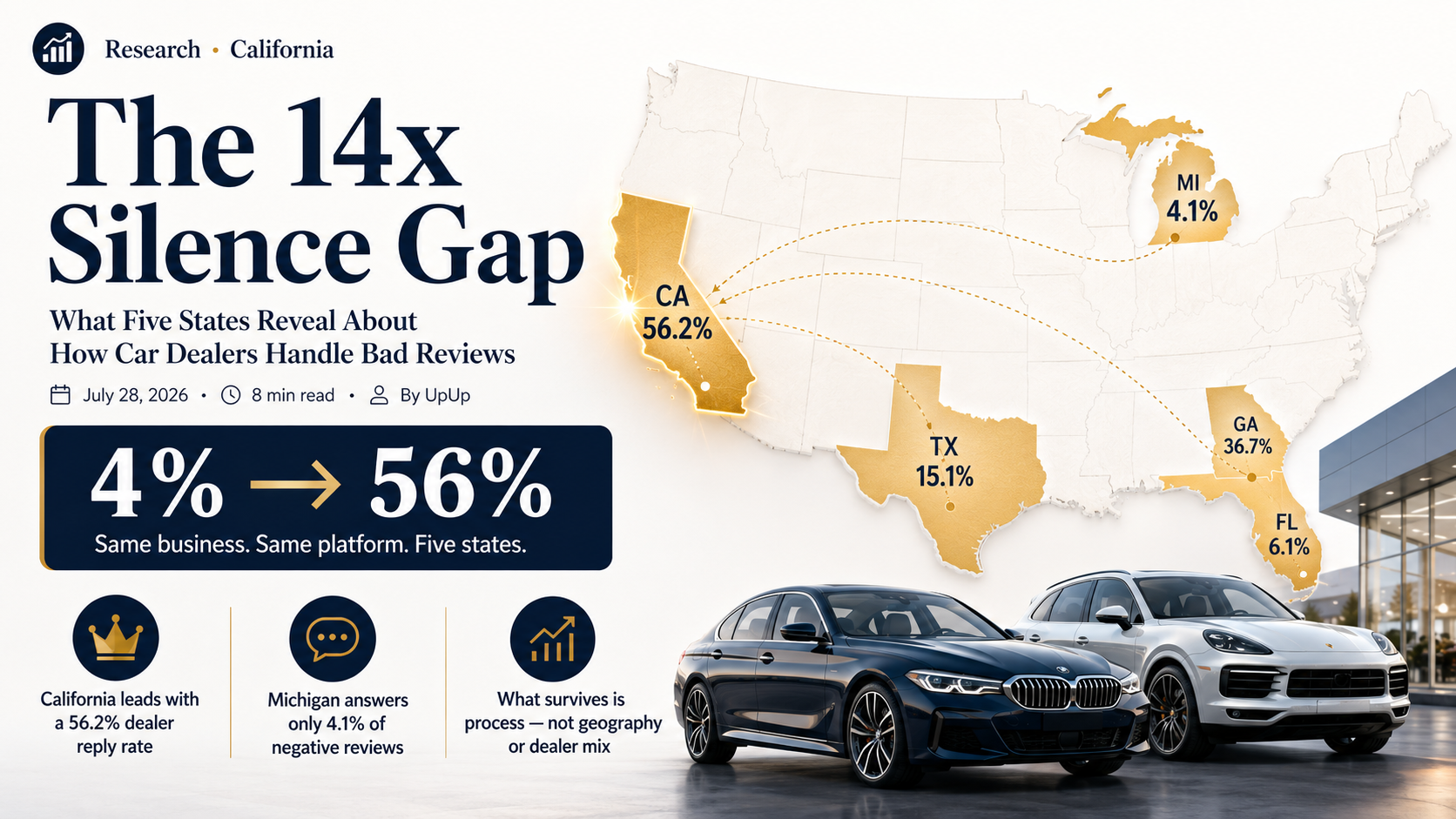
| Georgia | 15,416 | 36.7% |
Florida and Texas are preliminary estimates; Michigan and Georgia are fully validated against the database as of July 2026.
All four states went through the same validation: an aligned period (2023+), a separate cut for one-star reviews only, and checks for templated duplicates and response concentration. On the strictest cut (one-star reviews only, 2023–2026), the gradient holds: ~4.5% · 7.0% · 17.2% · 37.9%.
And a bonus finding from the protocol that explains a lot: in Michigan, the ten most active dealers produce 79% of the entire state's responses; replying there stays the business of a handful of stores. In Florida the top ten produce 39% of responses, in Texas 21%, and in Georgia just 11%. The higher a state's response culture, the more widely it is distributed across the market: in Georgia, it is not the champions who reply, but everyone.
The gradient taking shape, from 4% in the north to 37% in the south, is, for now, an observation, not a conclusion. But even now it means one simple thing: silence in reviews is not a natural law of the used-car market. It is a local norm. And norms, unlike laws, change, driven both by those who reply first and by those who build a process for it.
Methodology note. 1–3 star Google reviews of Georgia used-car dealers (metro Atlanta, Macon, Savannah, Augusta, and others), collected in July 2026; the sample was 400 lots: the top 250 by review volume plus a random selection of smaller ones, from a base of 1,277 dealers in the state; negative reviews were found at 364 of them. A “response” means a public owner reply visible on Google at the time of collection. Comparisons with Michigan use aligned cuts (2023+ period, one-star separately).