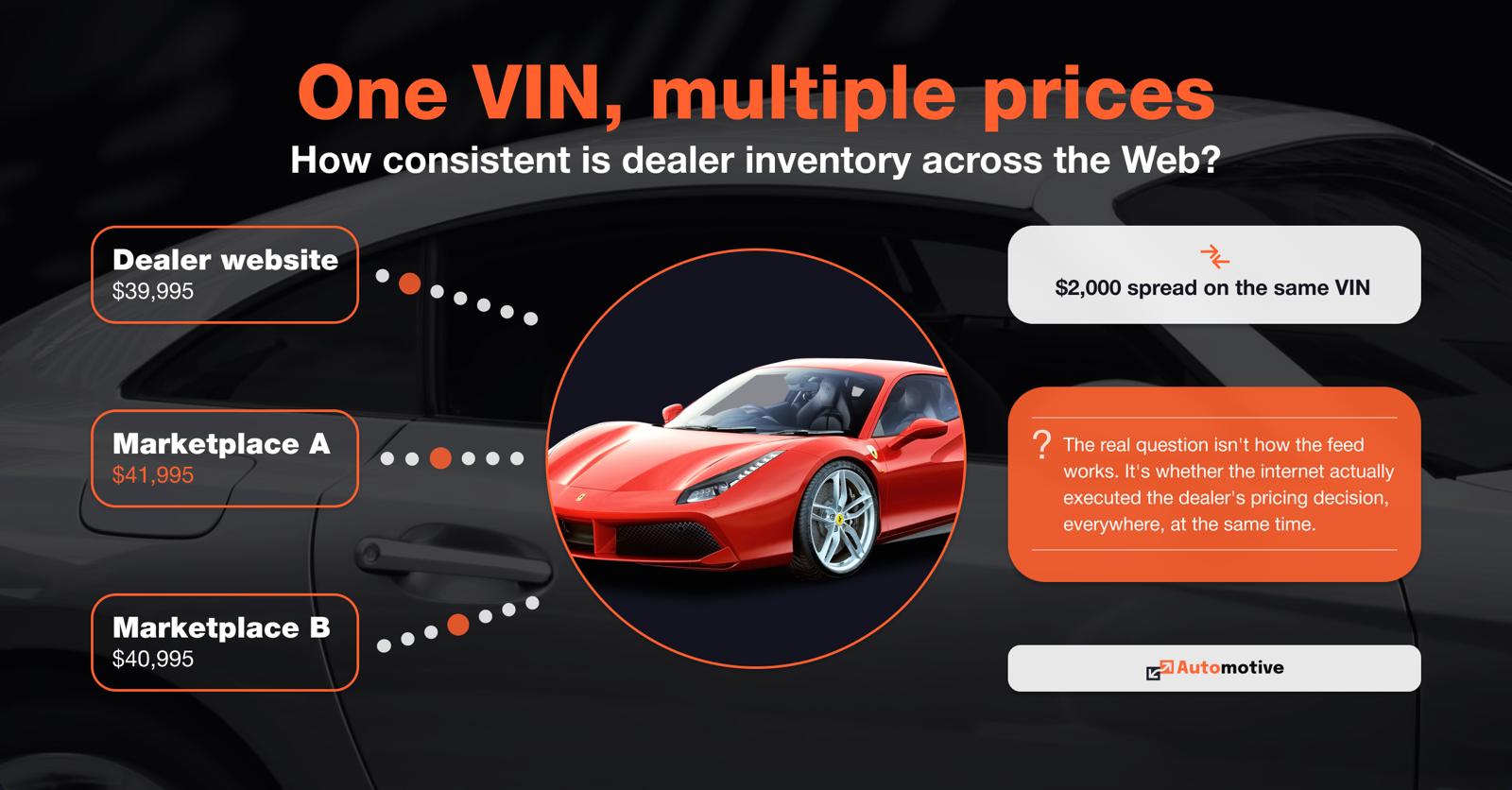
Here's a scenario that plays out constantly, on ordinary inventory, without anyone treating it as unusual:
- Dealer website: $39,995
- Marketplace A: $41,995
- Marketplace B: $40,995
Same VIN. Same car. Three prices, visible to anyone who cross-references a listing before picking up the phone.
The instinct, when a shopper (or a dealer) spots something like this, is to ask a technical question: how does the feed work? What broke? That's a reasonable question to ask an IT vendor. It is the wrong first question for the business.
The dealer made a pricing decision. This car is $39,995. The real question is whether the internet actually executed that decision, everywhere, at the same time.
Everything else in this piece is about why that reframe matters more than the technical one.
This isn't a one-off, it's a known pattern
The example above isn't a rare edge case. On consumer forums, buyers describe the exact same thing regularly. On the SpeakEV forum, several posters described noticing Autotrader prices that didn't match the price on the dealer's own website or windshield sticker, and more than one said this wasn't a one-off: one buyer described a recurring gap of roughly £1,000 between a marketplace listing and the dealer's own number. That's the same shape of gap as the $2,000 spread in the example above, showing up independently, described by people with no connection to each other, on ordinary inventory.
Some read this as strategy: a lower number on a marketplace full of price-comparing shoppers, with room to hold a firmer number closer to home. Others read it as exactly what it looks like, a sync problem, where one channel hasn't caught up with a price change made somewhere else. Both explanations turn up in the same threads. From where a shopper is standing, there's no way to tell which one they're looking at, and that's precisely the problem: the uncertainty itself erodes trust, regardless of the cause.
The clearest proof this is common: a product exists to solve it
The strongest evidence that "one VIN, multiple prices" is a widespread pattern rather than an occasional glitch is that a consumer tool exists specifically to solve it. FindPrices, a price-comparison service, is built on a stated premise: the identical vehicle is often cross-listed on Autotrader, Cars.com, CarGurus, and dealer sites at different prices, with price drops landing on each platform at different times. Its entire function is helping a shopper line up the same car's price across sellers before they start negotiating.
A product doesn't get built around a problem that happens occasionally. It gets built around a problem that shows up often enough, to enough people, that solving it is worth a business model.
On the dealer side, the same pattern shows up from the other direction: forum discussions on DealerRefresh show dealers tracking cost and performance differences between marketplaces like Autotrader and Cars.com for the very same inventory. That's a sign dealers already know, at some level, that a car doesn't behave identically once it leaves the dealer's own site and lands on someone else's platform, even before price consistency specifically enters the conversation.
Why "how does the feed work" is the wrong starting question
It's tempting to treat a $2,000 gap between three listings as purely a data-integration problem: stale cache here, sync delay there, a feed vendor to escalate to. That framing isn't wrong exactly, but it starts the investigation in the wrong place, because it assumes the answer is always technical.
Sometimes it is: a price change made in the DMS takes hours (or days) to propagate through syndication to every destination, and a shopper catches the car mid-sync. Sometimes it isn't: a dealer deliberately holds a different number on a high-comparison marketplace than on their own site, as a segmentation strategy, and the "inconsistency" is intentional. Both of these are real, and they require completely different fixes: one is an integration problem, the other is a pricing-policy decision.
That's exactly why the framing matters. Asking "how does the feed work" jumps straight to a technical fix, and might solve the wrong problem, or worse, "fix" a discrepancy the dealer actually intended. Asking "did the internet execute the decision the dealer made" forces a first step that has to happen before any of the technical work: confirming what the dealer's actual intended price was, on that VIN, at that moment, and only then checking whether every channel reflects it.
What this means in practice
For a shopper, a $39,995 / $41,995 / $40,995 spread on one car doesn't read as three data sources with three different sync timestamps. It reads as: this dealer doesn't have a firm answer for what this car costs. That's the cost of the gap, regardless of its cause, and it's paid on every listing where it shows up, not just the ones large enough to notice at a glance.
Sources
- SpeakEV forum: buyers reporting Autotrader prices that didn't match the dealer's own website or windshield sticker, including a recurring gap of about £1,000.
- FindPrices: a consumer price-comparison service premised on the same vehicle being cross-listed on Autotrader, Cars.com, CarGurus, and dealer sites at different prices, with drops landing on each platform at different times.
- DealerRefresh forum: dealers tracking cost and performance differences between marketplaces like Autotrader and Cars.com for the same inventory.
Note. This piece is an analysis of a publicly described pattern, drawn from consumer and dealer forum discussion and from the existence of a purpose-built price-comparison tool, rather than an original dataset. Prices shown are illustrative. Last updated: September 14, 2026.