Most dealerships do not have a software shortage. They have a software strategy problem.
Over time, it is easy to accumulate separate systems for DMS, CRM, inventory management, website, digital retail, service, marketing, payments, marketplaces, and reputation management:
- DMS
- CRM
- Inventory management
- Website
- Digital retail
- Service
- Marketing
- Payments
- Marketplaces
- Reputation management
Every product may solve a legitimate problem. But eventually the dealership should ask: do we actually need all of these systems, and are they working together in a way that makes the business better?
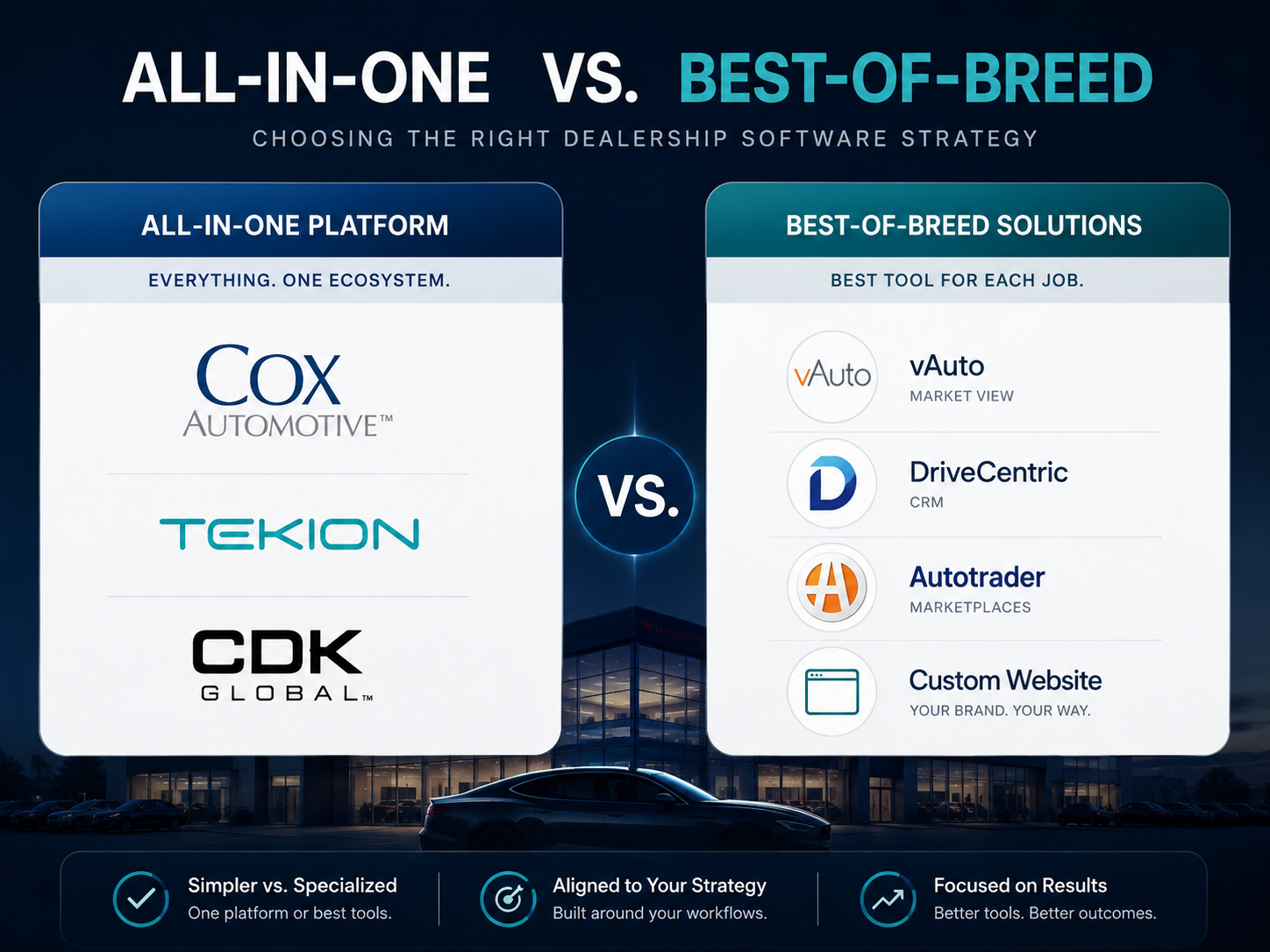
There are two common approaches: All-in-One and Best-of-Breed. Neither is automatically better. And today, the difference between them is not as simple as "one system vs. many systems."
Option 1: All-in-One
With an All-in-One strategy, one vendor provides several major dealership functions. That might include:
One vendor, responsible for a larger part of the stack.
The biggest advantage is usually simpler ownership. You have fewer vendor relationships, fewer contracts, and one company responsible for a larger part of the technology stack.
But there is an important distinction: All-in-One does not necessarily mean integration-free. Large automotive platforms can still consist of separate products, modules, services, or databases that exchange information through internal APIs, native integrations, or shared platform services.
So the real advantage is not "no integrations." It is more often fewer external integrations, and one vendor responsible for more of the connections. That can make troubleshooting, support, and data management easier.
When All-in-One makes sense
It can be a strong fit when:
- you want fewer vendor relationships
- your workflows are relatively standard
- the native modules fit your teams well
- you do not want to manage multiple third-party connections
- simplified support is important
- implementation speed matters more than deep customization
The trade-off: dependency
The more of your operation one vendor controls, the more dependent you become on that ecosystem. A company may have an excellent DMS but a CRM your sales team does not love. Its accounting may be strong while its website or inventory tools are less suited to your operation. And if one vendor controls most of the stack, replacing one component later can become more difficult. This is Vendor Lock-In.
The question should not be "How much can we buy from one vendor?" It should be: which parts of our operation actually benefit from being consolidated?
Option 2: Best-of-Breed
Best-of-Breed means choosing specialized products for different parts of the dealership. For example:
The advantage is flexibility. Your sales team can use the CRM that fits its workflow. Your used-car department can use the inventory platform it prefers. Your website can be designed around the dealership rather than around the limitations of another platform. And if one component stops working for the business, it may be possible to replace it without rebuilding the entire technology stack.
Best-of-Breed is easier than it used to be
Historically, the obvious downside of Best-of-Breed was integration complexity. That is becoming less of a problem. Many automotive software providers now have prebuilt integrations, partner integrations, APIs, webhooks, app marketplaces, and established integration programs.
So adding a specialized product does not necessarily mean building a custom integration from scratch. The more important question today is: how deep is the integration?
For example, one CRM integration may receive only:
A shallow integration.
Another may also receive:
A deep integration, and some can sync in both directions.
All of them may technically be described as integrations. Operationally, they are very different.
The real difference is ownership
This is where the distinction between All-in-One and Best-of-Breed becomes clearer. With All-in-One, you may still have integrations, but they are often native connections inside the vendor's own ecosystem. With Best-of-Breed, you are more likely to have connections between different vendors.
Neither model guarantees better data flow. The important questions are:
That is much more useful than simply asking "Do these products integrate?"
The systems can work while the dealership process does not
This is one of the most important things we see in dealership technology projects. The individual products are often not the problem. The problem appears at the handoff between them. For example:
Nothing necessarily crashed. The DMS may be working. The website may be working. The integration may even be working exactly as designed. It may simply update too slowly for that workflow.
The same thing can happen with leads. A customer submits an inquiry for a BMW X5. The CRM receives:
But loses:
Technically, the lead arrived. Operationally, valuable context disappeared. This is why dealership software should be evaluated as a system, not as a collection of products.
The website deserves a separate decision
Most dealership software operates behind the scenes. The website does not. It is one of the first parts of your technology stack the customer actually experiences.
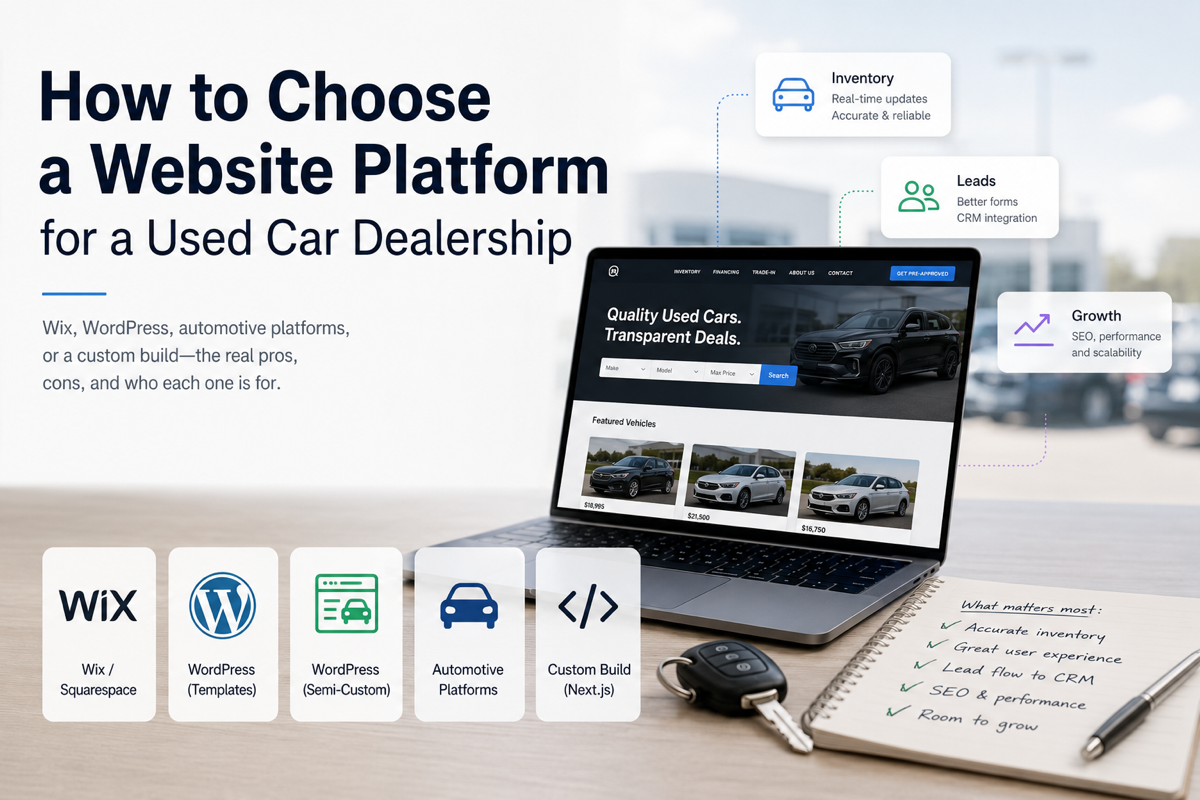
Standard automotive website platforms solve an important problem: scale. They can provide ready-made inventory pages, VDPs, forms, finance CTAs, trade-in tools, integrations, and common dealership functionality. For many dealerships, that is exactly what they need.
But scale also creates standardization. When the same structures and components are reused across large numbers of dealerships, the websites can start looking and behaving very similarly. The dealership changes. The logo changes. The inventory changes. The overall digital experience often changes much less.
For a dealer primarily competing on inventory and price, that may be completely fine. For a luxury, specialty, or strongly branded dealership, it may not be.
Where a custom website makes sense
A custom website can provide much more control over brand presentation, vehicle merchandising, the SRP and VDP experience, mobile UX, navigation, interactions and animation, lead flows, content, SEO, performance, and conversion optimization.
A dealership selling $100,000 or $200,000 vehicles may reasonably ask whether its online experience should look almost identical to hundreds of other stores.
But custom does not automatically mean better. A beautiful website that displays sold vehicles, receives inventory late, or sends incomplete leads to the CRM is still a bad dealership website. The customer experience and dealership infrastructure have to work together. For example:
And when a car sells, the change should reach the site quickly:
The front end can be differentiated. The infrastructure behind it should be predictable and reliable.
Are you paying for software your dealership barely uses?
Dealer owners should regularly look for:
- two products solving nearly the same problem
- functionality already included elsewhere
- employees entering the same information twice
- software staff regularly bypasses
- integrations that require manual correction
- subscriptions nobody can clearly connect to revenue, savings, or better operations
The true cost is not just the subscription. It includes:
This is the Total Cost of Ownership. Sometimes consolidating around one vendor reduces that cost. Sometimes replacing one weak module with a specialized product creates much more value. There is no universal answer.
Before adding another vendor, ask what it changes
Every additional software product should ideally do at least one of four things:
- Increase revenue
- Reduce cost
- Save staff time
- Solve a measurable operational problem
If it cannot clearly do one of those things, the dealership may simply be adding:
even if the integration itself is easy.
The most practical approach may be somewhere in the middle
For many dealerships, the best strategy is neither extreme. It is Core Platform + Best-of-Breed where it matters. Keep foundational operations on a stable core platform. Then use specialized products where they create a measurable advantage. For example:
Specialized products, added only where they create measurable value.
The exact combination will be different for every dealership. The important part is that every product has a clear reason to exist.
10 questions to ask before changing dealership software
Before adding or replacing a vendor, ask:
- What business problem are we solving?
- Do we already pay another platform for similar functionality?
- Which system owns the important data?
- Is there already a supported integration?
- Who owns and supports that integration?
- What data actually moves, and in which direction?
- Is it real-time, scheduled, read-only, or read/write?
- What happens when synchronization fails?
- Can we export our data if we leave?
- What else would need to change if we replace this vendor later?
Those questions usually reveal much more than a feature comparison.
The real decision
The question is not simply "All-in-One or Best-of-Breed?" The better question is: which parts of our dealership should be standardized, and which are important enough to deserve a specialized solution?
All-in-One does not mean there are no integrations. Best-of-Breed does not mean every integration has to be custom-built. The real difference is increasingly about ownership, flexibility, integration depth, and control over data.
A dealership does not necessarily need fewer tools. It needs fewer tools without a clear purpose. That is the difference between collecting dealership software and building a dealership technology strategy.